
African startups are joining the AI race, on their own terms.
From Nairobi to Lagos to Johannesburg, local entrepreneurs are building on open source models to create AI applications for the African context and to provide the continent with a measure of data sovereignty and control.
The global AI market is dominated by a handful of giant US and Chinese tech companies. Africa, with a history of leapfrogging through stages of technology, is becoming a testbed for a bottom-up, distributed, local alternative that could be a model for not only the Global South, but the globe.
“We’ll have a global wave of private models and more open-source models,” Toffene Kama of Mercy Corps Ventures, which tracks and invests in cutting-edge tech trends in emerging and frontier markets, tells ImpactAlpha. “But there is a whole wave also coming from the ground, with smallish and micro models that could do the work in a much more efficient way, but for a very narrow problem.”
Such local sovereignty means lightweight AI platforms and applications that can work in areas where reliable energy, internet connectivity and compute power are lacking. Language models that include hundreds of African languages neglected by major Western models. In Kenya, Jacaranda Health is delivering pregnancy and post-natal advice to women via text messages. In Senegal, Tolbi analyzes weather data to help farmers optimize food production. African startups also are using AI to unlock credit, insurance and other financial services for marginalized communities.
Policymakers and investors are discussing Africa’s massive opportunity — and sudden risks — at this week’s Africa Forward Summit in Nairobi. The impact of AI and digital infrastructure, and how benefits will be shared, has likewise dominated other recent African forums.
“For us to assume that we can achieve growth, prosperity and development by sitting on the sidelines while the world and technology moves rapidly would be a mistake, and we’d be missing quite a significant opportunity,” Mike Mompi of Nairobi-based Enza Capital, told ImpactAlpha on the sidelines of the recent Africa Venture Capital Association summit. Enza has backed over 60 companies using technology to solve large and meaningful problems across Africa, including AI companies. Its third fund, which is about halfway to its $60 million to $80 million target, is focused entirely on AI startups.
“People are saying that the train has left the station, that AI’s done, that Silicon Valley’s figured it out,” he added. “That’s not true. They have built very impressive technology that is relevant for the US and the world. But that does not mean that Africa cannot build around technology.”
The need for local data was underscored by last year’s high court ruling in Kenya that suspended a five-year $2.5 billion health cooperation deal with the US, to support programs in HIV/AIDS, tuberculosis, malaria, maternal and child health and help in disease surveillance. The agreement was suspended by the high court as it contravened multiple health data protection rights. Ghana rejected a similar health deal citing data sovereignty concerns. Zambia rejected the deal out of data concerns and needing the deal to be delinked from its minerals.
Nonetheless, AI optimism is strikingly high in Africa. In a Pew study conducted last fall, respondents in Nigeria and Kenya were much more excited about the prospect of AI than their counterparts in more developed Western countries. In the US, a populist backlash is growing against AI and the massive buildout of data centers to power it.
Some Africans seem more confident that adopting AI will create, not destroy, jobs for their growing youth population. And the diffusion of knowledge and expertise enabled by AI can increase productivity for farmers, healthcare and other sectors, and boost economic growth.
“I think there are huge efficiency gains,” says Mompi. “We’re looking at GDP per capita and increasing through innovation and efficiency.” That, he says, will in turn drive growth.
AI for good
Many of the AI-based applications being developed in Africa are designed for low-connectivity and compute environments. Startups solving key problems for marginalized communities can iterate and deliver products to the market faster. AI coding solutions have brought down the cost of production, including high pay for software teams.
Mercy Corps Ventures runs accelerator programs focused on AI for climate resilience and for financial resilience. With both programs, Mercy Corps is looking to support startups that combine AI and satellite imagery to predict drought and other climate shocks, information that is key in providing parametric insurance.
Its portfolio includes US-based Floodbase, which provides AI-powered satellite analysis for flood mapping to support parametric insurance. It teamed up with the African Union’s insurance unit African Risk Capacity in 2023 to develop parametric insurance products. From Senegal, Tolbi uses AI to analyze and provide data on weather patterns, irrigation requirements, soil health, and crop needs across Francophone Africa.
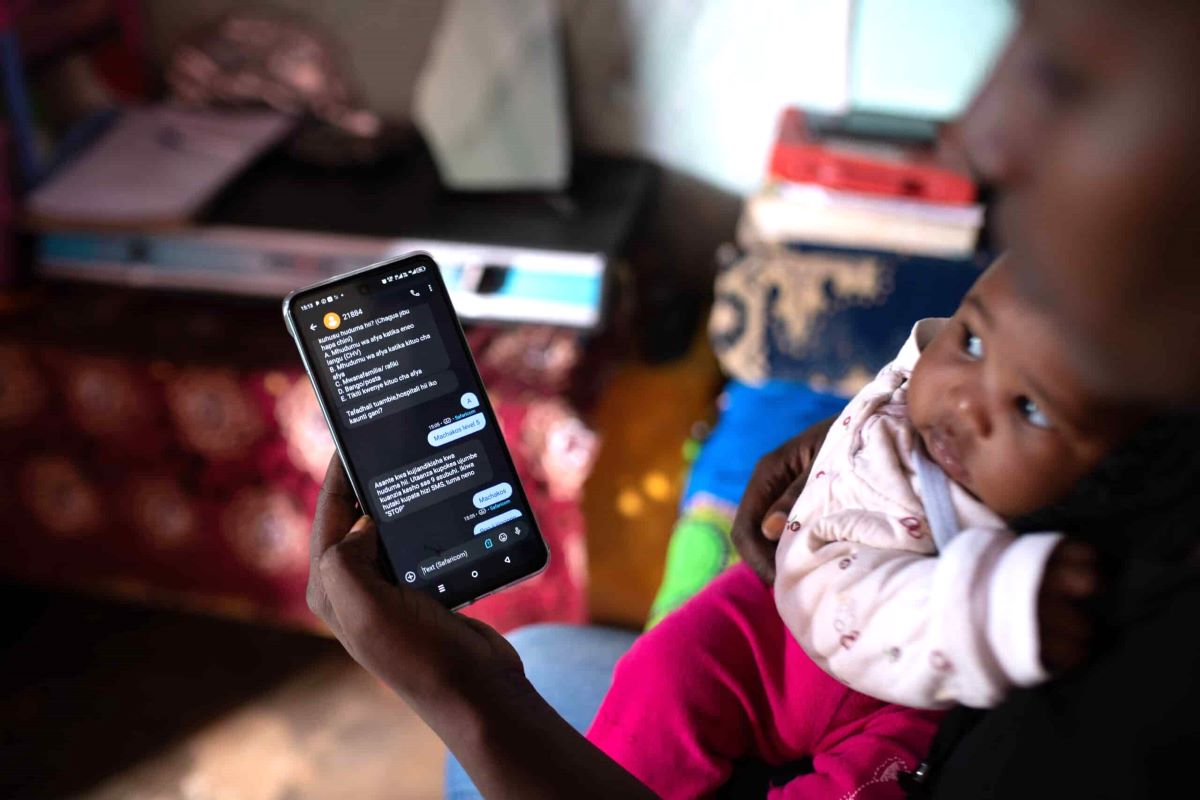
In Kenya, the non-profit Jacaranda Health, which partners with governments to provide access to quality maternal healthcare and reduce infant mortality in low resource areas, rolled out an AI feature with support from the Rockefeller Foundation. Called PROmoting Mothers in Pregnancy and Postpartum Through SMS, or PROMPTS, it operates as a two-way SMS exchange in Swahili to address mothers’ questions throughout various stages of their pregnancies, as well as offer post-natal advice.
California-based Digital Green launched FarmerChat in partnership with Open AI and with Rockefeller Foundation’s support to allow farmers in Kenya, India, Nigeria and Brazil to access agronomic advice in local languages and government resources via messaging apps Whatsapp and Telegram.
Kenya-based Cliniva, complements its two mini-clinics for women in Nairobi with an AI chatbot embedded into Whatsapp. The company built its service on top of OpenAI’s open resources and Google’s MedGemma, a collection of open models for health AI development. Cliniva had received grant funding, as part of a cohort of the Chat for Health and AI Accelerator, launched last year by the Johnson & Johnson Foundation and Mulago Foundation, Turn.io and OpenAI to support innovators expanding healthcare access in low-resource settings using AI-enabled chat services.
Cliniva’s Yulia Sidorova says she is concerned about AI models that are trained on global patient data, which doesn’t capture the realities and needs of African patients.
“What worries me is that my patients are completely invisible to foreign models,” she says. “It’s not just an equity issue. A pregnancy in rural Kenya is completely different from a pregnancy in London, just even clinically. Without training [AI models] on local data, they can become dangerous.”
At the moment, “developing local models is very expensive and it always comes down to economics,” Siderova says. Cliniva’s strategy is to continue building on existing open models introducing its own guardrails, memory, and its own data.
Five-layer cake
If Africa’s first wave of AI startups has focused on applications of the technology to persistent challenges, from food production to financial services to health care, the second is focused on the AI infrastructure itself, from data centers to large language models and the data used to train them (see, “Investing across the tech stack to orchestrate ‘good AI’”). Nvidia’s Jensen Huang describes a five-layer cake that includes energy, chips, physical infrastructure and AI models as well as applications.
Building it in an inclusive way is the key. Open source AI can help democratize AI innovation and reduce reliance on expensive proprietary technologies, according to the Global Center on AI Governance, which released a report on the AI landscape in Africa last year.
Community‑specific AI projects, like The Huniki Federation, a cooperative venture of African language tech startups, can help communities control data, goals and deployment. “I don’t want to build one model for everything,” said Timnit Gebru of the Distributed Artificial Intelligence Research Institute at South by Southwest in Austin earlier this year.
“I want to build many models for many different kinds of people in the world, because there’s no one way of being human.”
The Rockefeller Foundation is championing building African databases to drive AI localization. This allows companies like Jacaranda Health’s or Digital Green’s to offer tailored services in local languages for marginalized populations rather than generic services.
“What is top of mind is the need to actually build the data sets, both because it is important in order to have that data to be able to support AI and large language models, but also because it will help communities and other people understand the continent,” Rockefeller’s Elizabeth Yee says. “Ultimately, without data, finance doesn’t come, so those two things need to work in tandem.”
In addition to broader digitization efforts, bringing some of Africa’s more than 2,000 languages into AI models is a key focus. Johannesburg-based Lelapa AI, for example, is building models for African languages including Swahili, Yoruba, IsiXhosa, Hausa and IsiZulu, which have more than 350 million speakers. Its “small language models” are designed for real-world conditions with limited computing power, cloud infrastructure, and connectivity.
Masakhane, a grassroots organization whose name means “we build together” in isiZulu, works to empower Africans with AI models that embed cultural context and nuance.
Building and scaling African AI would also help the continent protect and steward its highly sought-after resources and data. Without African input and innovation, warns Enza’s Mompi, AI could become a new driver of extraction. “The world is taking undervalued products, adding value outside, and then selling it back [to Africa],” he says.
Hakimu, an Enza portfolio company, is building a language model trained on unpublished African court cases to enable faster legal research proceedings, which lag due to unstructured information. VoLo Earth Ventures backed the US and South Africa-based Refiant AI, which is compressing large language models to curb AI energy usage.
“We have fragmented markets. There’s a lot of data that does not exist in a structured way,” he continues. “There’s a lot of work that needs to happen to structure data, to incorporate local languages, to build platforms now on the foundation that is African, and to then solve the problems locally.”