
A major source of African development financing is undergoing a significant transition after a tumultuous year.
The Mastercard Foundation, with approximately $55 billion in assets, is one of the five largest philanthropic institutions in the world, and one of few of its scale working primarily in Africa. The foundation is a major funder of African investment managers, nonprofits and social enterprises.
Three months into a leadership change, participants in and observers of Africa’s growth story are hoping the foundation’s new CEO will usher in increased transparency, efficiency and catalytic philanthropy for the institution.
Sewit Ahderom took the helm of Toronto-based Mastercard Foundation in January, succeeding Reeta Roy, who stepped down as CEO after leading the institution for 18 years. The significance: As I argued in a piece last year, Mastercard Foundation’s new president could be more consequential for the continent’s economic trajectory than even the incoming president of the African Development Bank. Amid global tumult and the Trump administration’s upending of development assistance, MCF funnels billions of dollars each year to development projects and organizations in Africa.
The foundation was established in 2006, in conjunction with Mastercard Inc.’s initial public offering, as a Canada-based philanthropy that operates separately from the payments giant.
When the foundation began its work in Africa, soon after it was established, it was focused on a single theme: expanding education and economic opportunity for young Africans. Under Roy’s direction, MCF’s strategic footprint grew to include education reform, financial inclusion, climate change, and country-specific plans that now stretch across 29 of the continent’s 54 countries. The result is a strategy that is wide but not sharply anchored.
The challenge for the foundation, and its new leadership, is to refocus attention on a few problems that it can truly help solve, and to realign its initiatives with clarity around those goals.
(Editor’s note: MCF’s chief program officer Peter Materu told ImpactAlpha: “We always try to get the balance right between the diligence that responsible stewardship of philanthropic capital requires and the speed and clarity that our partners – often lean and ambitious organizations – need from us. These are real operational challenges that we are always actively working to address.”
“Over the past year, we have taken concrete steps to streamline grant-making pathways, reduce the number of internal touchpoints partners must navigate,” he added. “We do not think the answer is to abandon rigor, the responsible use of charitable resources demands it, but we recognize that rigor and agility are not opposites, and we have more work to do on that balance.”)
Accountability gap
In Africa, the difficulty of working with MCF, as both a grantee or partner, has been a poorly kept secret for years.
My LinkedIn post last year helped blow those frustrations into the open. The article sparked extensive public and private commentary about MCF’s role as a funder for local economic and talent development in African markets. Much of the commentary was unusually candid, particularly from grantees who aired their frustrations in working with the foundation. Many said they feared funding repercussions about speaking publicly.
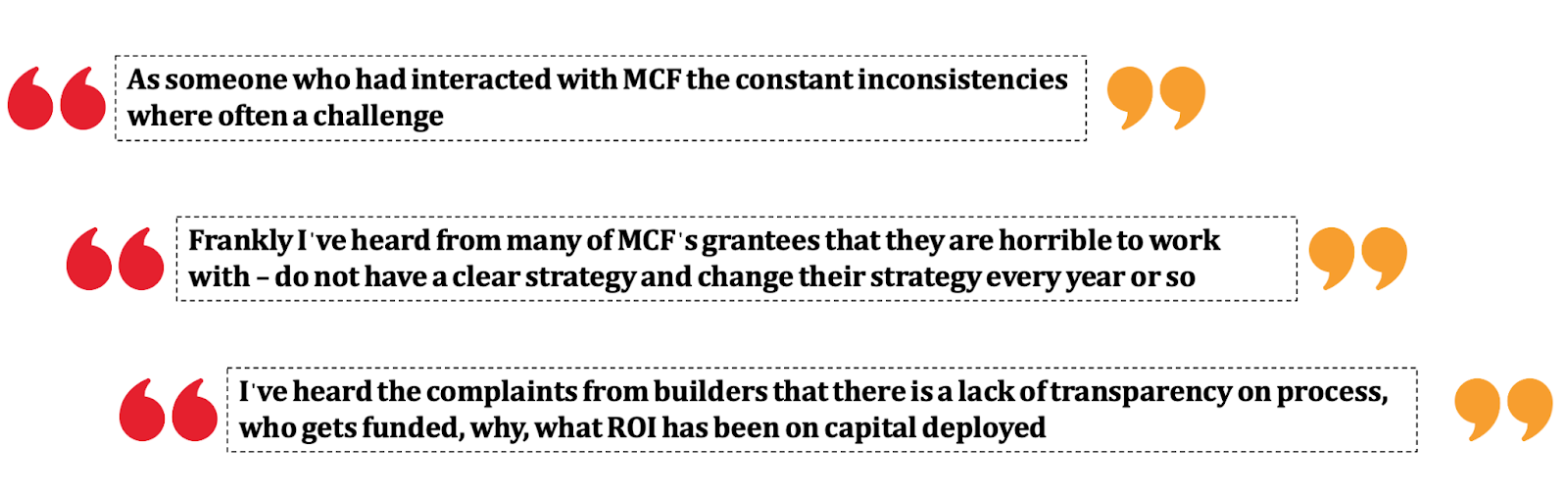
Informal benchmarking exercises and founder surveys, like those by Sunlight Reviews ranks MCF among the lowest of funders in recipient ratings. One reviewer shared that, “MCF has a tendency to ‘waste’ your time as I’ve seen happen multiple times. This has happened not just with us but with many other people.”
African operators consistently describe long decision cycles, repeated consultations with different MCF teams, and guidance that changes depending on who they speak to.
Such sentiments echo what many grantees say privately. These experiences are not just anecdotal. They point to a deeper structural issue: a lack of clear, consistent, and transparent reporting on how decisions are made and what results are achieved.
(Editor’s note: MCF told ImpactAlpha that it conducted a “partner survey” with grantees last year to better understand grantees’ funding needs and preferred focus areas for the foundation.)
Annual reports are a central mechanism through which philanthropies demonstrate accountability for their work. Financial statements show what was spent, but not what was achieved, how decisions were made, or what failed. Annual reporting fills that gap, providing narrative and context that make real accountability possible. For a foundation of MCF’s scale and ambition, the absence of one to date is less of an administrative oversight than a choice.
This gap is visible with MCF’s Young Africa Works strategy, a $4.7 billion initiative that launched in 2018 to enable 30 million young Africans to access dignified work by 2030. Only one of YAW’s seven country offices – Uganda – released a country progress report in 2025, six years after the strategy launched.
The available narrative reports often rely on broad terminology, like “participated in work-enabling activities” or “engaged in activities that support access to work,” that makes it difficult to assess impact outcomes achieved.
(Editor’s note: MCF shared that, for its 20th anniversary this year, it intends to issue its first impact reports for its Young Africa Works and another for the EleV program in Canada. “Measuring impact in the way our mission demands, not just who we have reached, but whether their economic lives have durably changed, is genuinely difficult work, and we have been deliberate and methodical in how we approach it,” Materu said. “We have resisted the temptation to publish impact claims before we can stand behind them with confidence. That means taking the time to build robust measurement frameworks with our partners, commission independent evaluations, and track outcomes over time periods long enough to be meaningful.”
Accountability currently flows in one direction. Partners report up to MCF, but MCF does not report back to the ecosystem it claims to serve. Private frustrations about strategic inconsistency, shifting priorities, opaque funding decisions, and moving goalposts persist in part because there is no public record against which to assess them.
Altogether, these are not cosmetic issues; they are signs that the foundation’s capability is being diluted by complexity and opacity.
Defining test
To be sure, the foundation’s heft and intentions in Africa are widely admired. It has wielded its funding might and influence in recent years through a number of very large, high-profile commitments. Among them, a $106 million grant to 54 Collective, once one of Africa’s most active startup investors.
Such big-bet philanthropy, however, can overwhelm organizations, distort incentives and leave fragile systems and people exposed when things go wrong. In the case of the 54 Collective, the partnership collapsed into a legal battle, with the studio provisionally liquidated after allegedly diverting grant funds to for-profit affiliates. Over 40 portfolio startups were left without support overnight and staff was fired.
What’s more, a single misaligned bet can erode trust far beyond one organization and damage investor confidence continent-wide.
(Editor’s note: MCF told ImpactAlpha that a liquidator has been appointed over the affairs of Africa Founders Ventures, and several outstanding matters remain in dispute. “Due to these ongoing proceedings, we are currently unable to share any further details on this matter,” Materu said. He added that in recent years, the foundation has refocused its efforts on making smaller grants to grassroots organizations, particularly those led by young people. About 78% of its grants last year were in amounts of less than $10 million, with many as small as $250,000).
The work for MCF’s new CEO is helping to restore the foundation’s reputation on the continent as a steady, long-term, supportive partner.
One advantage is that Ahderom has walked in the shoes of many MCF grantees. The founder of climate tech venture Gro Intelligence, she’s done the hard work and faced the pressures of building an impactful African startup from scratch. She brings a unique combination of technology, data, agrifood, and Africa-focused investment expertise to the role of MCF CEO.
She’s also intimately familiar with the foundation, having served on its board of directors since 2023.
Indeed, Ahderom’s candidacy for the top position raised some eyebrows among observers of Africa’s development ecosystem. Her tenure as Gro Intelligence’s co-founder and chief operating officer ended in February 2024, during a moment of turbulence for the company, which ultimately shut down. The company, cash-strapped and urgently working to procure new funding, was mired in several lawsuits related to employee wage claims, investor disputes and allegations of financial mismanagement.
People familiar with the company’s collapse are quick to defend Ahderom and her co-founder, Sara Menker. One startup founder and investor described both as “victims in that story much more than perpetrators” of the company’s volatility.
(Editor’s note: MCF told ImpactAlpha that Ahderom “parted ways with Gro Intelligence in February 2024 and was not party to or named in any of the legal disputes during or after the wind-down of the company.”)
In addition, Ahderom’s role on the foundation’s board and governance committee raised concerns about a perceived conflict of interest – a situation that nonprofit governance authorities and sector watchdogs consider problematic in executive hiring, given the informational advantage existing board members hold over other candidates.
These issues don’t diminish Ahderom’s qualifications. But they do raise questions about MCF’s approach to its leadership transition, and how candidates were identified and vetted.
(Editor’s note: MCF said that while Ahderom served on the board and a governance committee, she did not serve on the search committee and recused herself from selection decisions. “Sewit was not involved in the shortlisting, vetting, interviewing of candidates or selection for CEO,” Materu said.)
Ahderom’s challenge as MCF’s new leader is effectively “refounding” the organization – bringing it back to its original mission and values by reestablishing the enduring needs the foundation is uniquely positioned to address. What capabilities must be protected and strengthened, not expanded? Where has complexity replaced clarity? What systems must be rebuilt so that partners experience the foundation’s intent, not its bureaucracy?
MCF plays an important role in Africa’s development ecosystem. The new CEO doesn’t need to reinvent it; rather, the hope is that she can identify what matters, and reestablish clarity and focus to that work with the honesty and discipline it deserves.
Karim Mohamed is a development finance strategist and founder of InSight54, which advises angel investors, development banks and impact investors on capital deployment across Africa.