
Greetings Agents of Impact!
In today’s Brief:
- Trump’s policy disruptions
- Organic nitrogen fertilizer
- Sustainability buyout fund
- Adaptation finance ahead of COP30
Featured: Policy Corner
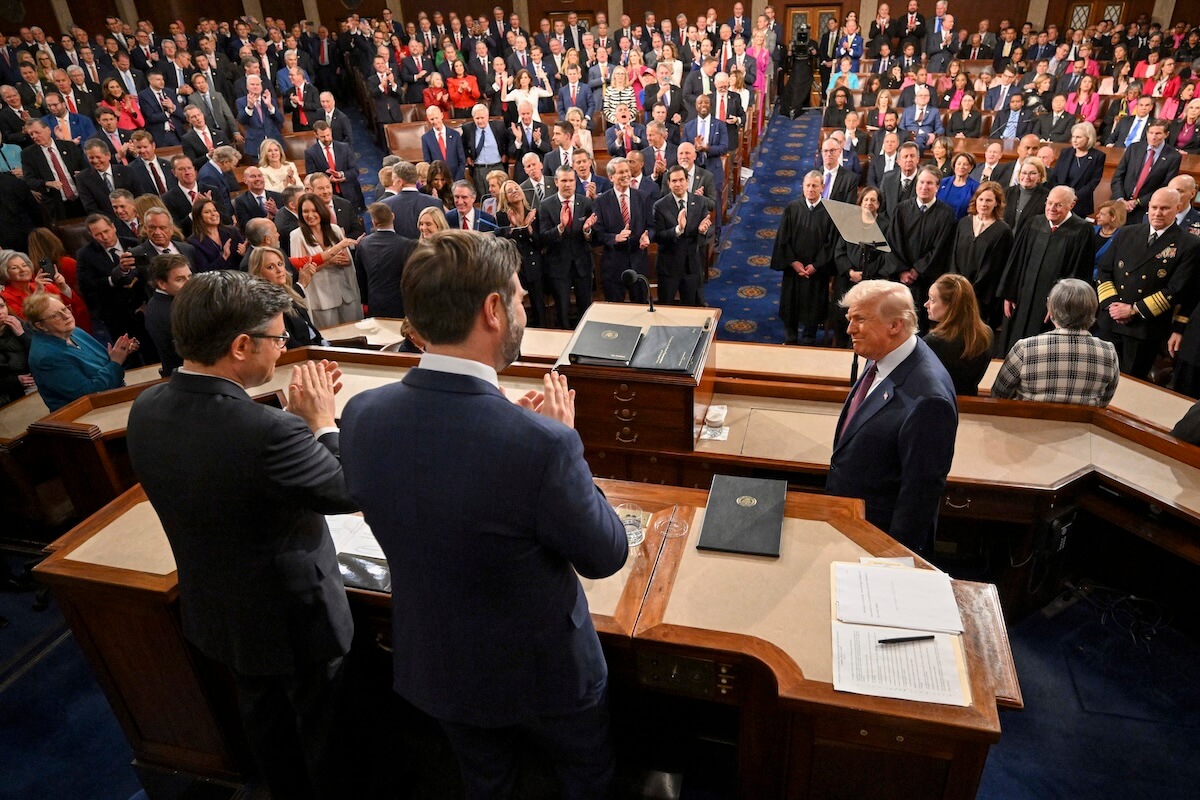
State of the Union: Five-alarm fire. Ok, Donald Trump’s speech last night wasn’t technically a SOTU. But the president’s address to Congress came as investors, companies and workers, as well as international allies, scrambled to assess the actual state of the nation a month and a half into Trump’s chaotic second term. Trump told Congress he’s fighting “to make America affordable again,” even as his tariffs raise prices on thousands of products. Trump claimed to have stopped government censorship and brought back free speech, even as he punishes protesters at US universities. Trump said he plans to balance the federal budget, as he pushed for $4.5 trillion in tax cuts skewed toward the rich, to be only partially offset by cuts to healthcare and other programs for the poor. His firehose of activity is “about making America rich again and making America great again,” Trump reassured. “And it’s happening, and it will happen rather quickly. There’ll be a little disturbance, but we’re okay with that.” Policy disruptions we’re watching:
- Trouble with tariffs. Trump’s commerce secretary may already be signaling a potential retreat on tariffs slapped on Mexico and Canada this week, but the trade war is already hitting the economy. Trump’s tariffs, including 25% on goods from Mexico and Canada, and 20% on goods from China, are expected to hit roughly a third of products coming into the US. Financial markets sold off on Monday and Tuesday; the S&P 500 has erased all of its post-election gains. CEOs of Target and Best Buy told customers to expect price hikes. The National Association Home Builders warned that the levies would slow housing construction amid a housing shortage and an affordability crisis. “The trouble with tariffs, to be succinct, is that they raise prices, slow economic growth, cut profits, increase unemployment, worsen inequality, diminish productivity and increase global tensions,” said JPMorgan’s David Kelly. “Other than that, they’re fine.”
- Green bank groups in the red – and in the dark. Trump called out Stacey Abrams for her links to a federal green lending program. Climate United, the Calvert Impact-led coalition that was awarded nearly $7 billion under the Greenhouse Gas Reduction Fund, has also been a target. On Tuesday, Climate United urged the Environmental Protection Agency to restore its access to the congressionally approved funds and explain its legal basis for directing Citibank, which holds the money, to freeze them (see, “EPA’s efforts to claw back ‘green bank’ funds hit a snag”). Climate United and other GGRF awardees have been unable to access the funds for more than two weeks, leaving them unable to pay staff and contractors or fulfill loans they have approved. The 12-page letter lays out the contractual terms and federal laws that EPA appears to be violating. “The current funding freeze harms the communities we serve, and we are taking the next step to ensure we can deliver on our contract,” Climate United’s Beth Bafford said in a statement.
- Returns on aid. Trump has nominated Benjamin Black, son of former Apollo CEO Leon Black, to head the US International Development Finance Corp., a development finance agency created by combining the Overseas Private Investment Corp. and parts of USAID during Trump’s first term. USAID has experienced “absurd mission drift,” with, for example, funding for gender and climate initiatives, Black and Joe Lonsdale wrote in January. US spending abroad should “advance American interests” and seek a “return on investment,” they said. Agents of Impact are setting the record straight. “USAID has promoted market-based solutions for decades,” says Anthony Bugg-Levine. “There is much more of an interplay between USAID’s work and expertise, and the ability to invest productively in many countries.” The aid cutbacks have upended thousands of projects and lives, as a top USAID official documented before being suspended, and given cover to European nations to slash such spending as well.
- Weaponizing diversity. Last week, The Chronicle of Philanthropy came under fire for publishing a list of foundations that may be targeted under President Trump’s executive order attacking diversity, equity and inclusion. Critics said the article itself targeted the foundations. “It compiles data without context or analysis,” and was “uncritical in its adoption of the administration’s weaponized definition of diversity, equity and inclusion,” wrote Nonprofit Quarterly’s Sara Hudson. “Treating diversity, equity and inclusion as a lurking danger, as opposed to our national gift, is a capitulation to authoritarianism.”
Dealflow: Agrifood Investing
Elemental Impact and Trellis Climate backs Nitricity’s organic nitrogen fertilizer plant. A group of Stanford graduate students launched Nitricity in 2018 to develop an affordable, climate-smart alternative to synthetic nitrogen fertilizer. Most synthetic nitrogen fertilizers are made through the “Harber-Bosch” process, a high pressure and temperature method that relies on fossil fuels. Nitricity uses air, water, renewable electricity and almond-shell waste to brew an odorless, pathogen-free fertilizer it says is cost-competitive with synthetic nitrogen fertilizers. The $10 million investment round, backed by Elemental Impact and Prime Coalition’s Trellis Climate fund, will help finance a production facility in California’s Merced County. “In a market where most nitrogen is imported, our solution onshores production to deliver exactly what growers have been asking for: a sustainable, organic alternative that strengthens farmers’ bottom lines and benefits our community and environment,” said Nitricity’s Nicolas Pinkowski.
- Enabling regenerative ag. Nitricity’s plant, which is projected to begin operating next year, could produce hundreds of tons of low-carbon fertilizer by 2028. The facility’s capacity is sold out through its first two years of operation via offtake agreements with local organic growers. It will create 20 local green jobs over two years, the company says. “Nitricity’s facility proves sustainable fertilizer can be produced at scale while providing local economic benefits,” said Elemental Impact’s Danya Hakeem. Elemental backed Nitricity’s Fremont facility in the San Francisco Bay Area in 2022. “There’s clear market demand that will position them for future commercial financing,” Hakeem said. Nitricity’s investors have included Energy Impact Partners, Lowercarbon Capital and MCJ Collective.
- Share this post.
Eurazeo secures €300 million first close for Planetary Boundaries Fund. Investors in the fund’s $318.5 million first close include European financial institutions, insurance companies, asset managers and family offices. The Paris-based impact buyout fund, which started raising 10 months ago, has a target of €750 million (about $796 million). Eurazeo will use a “buy-and-build” strategy to scale up small and mid-sized companies addressing environmental challenges such as pollution and biodiversity. The first close “is a step forward in our ambition to become the leading European private market asset manager in the mid-market, growth and impact segments,” said Eurazeo’s Sophie Flak. “Investors recognize the need and opportunity to scale businesses providing solutions toward the environment.”
- Eco-friendly. In its first deal, the Planetary Boundaries Fund acquired a majority stake in Bioline AgroSciences, a UK-based crop management company that offers growers environmentally friendly products to manage agricultural pests. The fund backed Bioline alongside Aurae, a French family-owned impact investment fund. Bioline operates six factories in the US, UK, France, Spain and Kenya, making products for flowers, fruits and vegetables and other high-value crops.
- Check it out.
Dealflow overflow. Investment news crossing our desks:
- Tandem PV raised $50 million in a Series A round backed by Eclipse, Constellation Energy and Planetary Technologies to build a commercial-scale perovskite solar manufacturing facility in San Jose, Calif. (Tandem VC)
- Ghana International Bank and British International Investment have formed a $50 million partnership to address Africa’s trade financing gap in Sierra Leone, Liberia, Gambia, Benin, the Democratic Republic of the Congo, Rwanda and Tanzania. (BII)
- Amsterdam-based Moonwatt snagged €8 million ($8.5 million) in a round co-led by French VC Daphni and LEA Partners to build sodium-ion battery energy storage systems co-located with solar power plants. (TechCrunch)
- California-based Care Solace, which partners with school districts and municipalities to connect individuals with community-based mental health providers, secured a strategic growth investment from philanthropic venture investor Lemnis. (Care Solace)
Signals: Climate Finance
Adaptation finance faces stalemate ahead of COP30. Calls for increased climate funding are running up against global political realities in the run up to this year’s UN Climate Conference in Brazil. Following this year’s unprecedented flooding of the Rio Grande, wildfires in the Amazon, extreme drought, heat waves and other climate shocks, Brazil plans to prioritize adaptation and resilience at COP30. The challenge: Unlike climate mitigation efforts, which benefit the planet as a whole, climate adaptation is more locally-focused. At a conference in Brasilia last week, the think tank Instituto Talanoa sought to chart a path forward, Climate Proof’s Louie Woodall reports for ImpactAlpha. “If I don’t mitigate [emissions] in Brazil, every person sitting in Norway or the UK or China or the US, they will be impacted,” explained Brazil’s COP30 executive director Ana Toni. “But if I don’t adapt in Brazil, you’re not directly suffering.”
- Innovative models, please. The gathered climate diplomats in Brasilia called for innovative financing models, including more efforts to “crowd in” private financing. Mirova Sustainable Land Use Fund combines capital from development finance institutions and private providers, including Allianz France and BNP Paribas Cardif, to invest in sustainable agriculture and forestry and restore degraded land. Another focus: reforming the practices of multilateral development banks, or MDBs. While MDBs have distributed tens of billions of dollars in adaptation finance, poorer nations say projects are delayed by bureaucratic hurdles and onerous reporting requirements. Avinash Persaud of the Inter-American Development Bank and an architect of the reform efforts known as the Bridgetown Initiative, argued that MDBs must shift to “low-cost, AAA-rated, guaranteed” loans with disaster clause and multi-decade terms.
- Biodiversity COP. On a separate COP track, more than 140 countries have agreed to mobilize $200 billion a year by 2030 to reverse biodiversity loss. Negotiators at the UN’s Biodiversity Conference, or COP16, hammered out the new commitment in Rome last week, following an inconclusive meeting in Cali, Colombia, in October (see, “Breaking down barriers to addressing the climate crisis”). The agreement is being hailed as a win for multilateralism in the face of global tensions. The promised funds will be used to meet the goals of the 2022 Kunming-Montreal Global Biodiversity Framework, which include reversing biodiversity loss, protecting at least 30% of the planet’s land and seas by 2030, and safeguarding clean water. Contentious issues remain, including the creation, and independence, of a permanent global nature fund. A decision has been deferred to 2028. The US is not a signatory to the UN Convention on Biodiversity and chose not to send a delegation to the sidelines of the Rome gathering, as it had in Cali.
- Keep reading, “Adaptation finance faces stalemate ahead of COP30,” by Louie Woodall on ImpactAlpha. Follow Woodall’s coverage and sign up for his newsletter, Climate Proof.
Agents of Impact: Follow the Talent
DC Advisory hires Jacque Noel, ex-of Scotia Bank, as a director in its Global Infrastructure Group… Washington, DC-based impact fund manager Zeal Capital Partners promotes Stefanie Thomas from managing director to partner… Nonprofit Finance Fund brings on Kareem Thomas, formerly with Reinvestment Fund, as chief credit officer, and Names Bhavani Daryanani, previously with Capital for Change, as chief financial officer.
Rebecca Brown, former vice president of Global Advocacy at the Center for Reproductive Rights, joins the Center for International Environmental Law as president and CEO… The Nature Conservancy is looking for an associate climate director in Seattle… ClearBridge Investments seeks a senior ESG associate in New York… Also in New York, Expedia Group is recruiting a climate and sustainability senior manager… GreenLight Fund is on the hunt for a director in San Francisco.
The Inter-American Development Bank is hiring a program and innovation strategy analyst in Washington, DC… Also in Washington, the Aspen Institute is searching for an executive director… SoLa Impact is looking for a private equity investments intern in Los Angeles… Growald Climate Fund has an opening for a senior manager for its venture portfolio in Boston… Project Frame will host a community meeting to discuss the challenges and opportunities AI presents for climate tech on Wednesday, March 12… ICCR is hosting a webinar to share a preview of their members’ 2025 shareholder proposals, Tuesday, March 21.
👉 View (or post) impact investing jobs on ImpactAlpha’s Career Hub.
Thank you for your impact!
– March 5, 2025