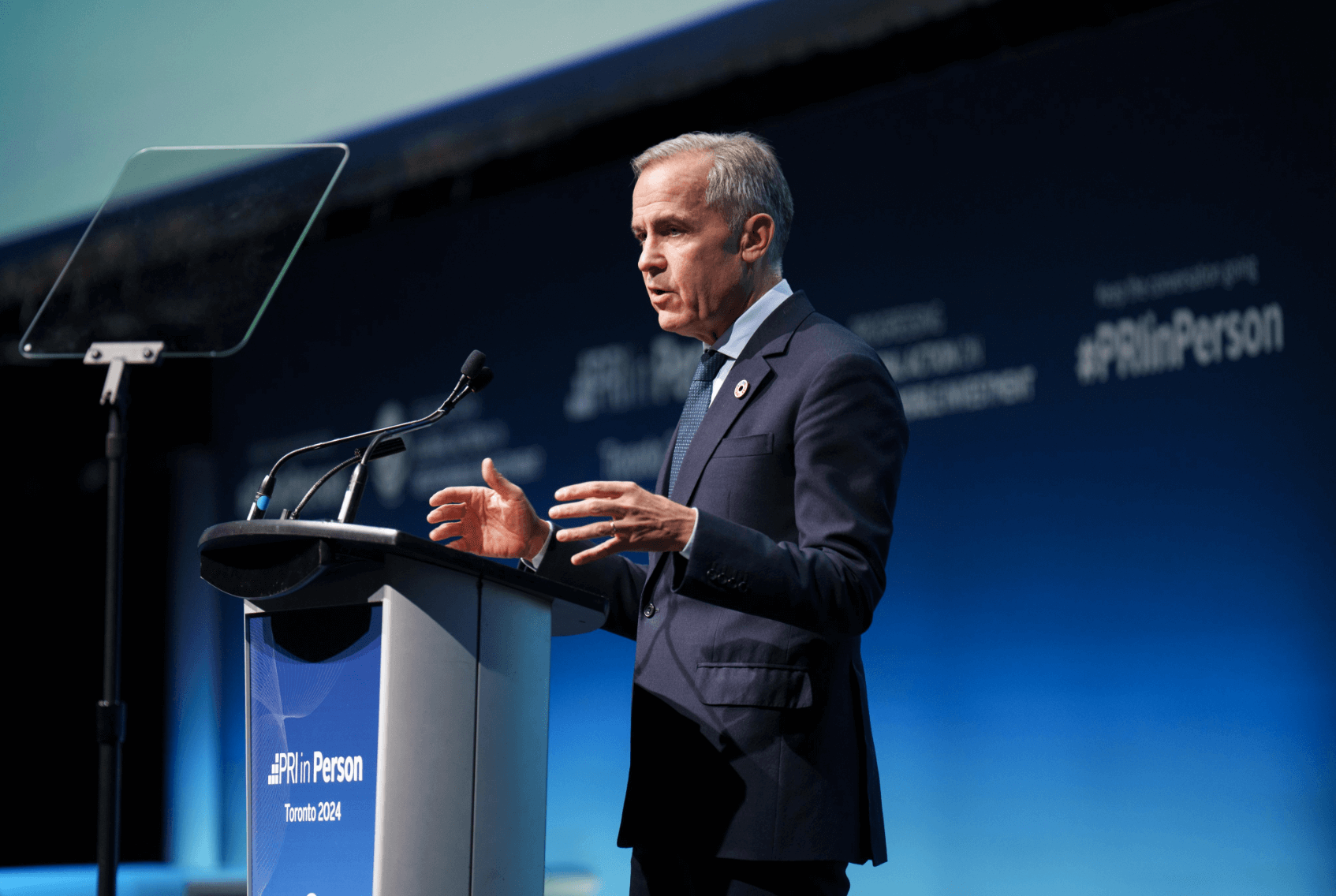

The path forward for responsible, sustainable, and impact investing may be as complex as the challenges we face. Among investors at this year’s PRI in Person conference in Toronto, there was a growing recognition that system-level solutions offer our best chance at addressing interconnected crises such as climate and inequality.
As a glass-half-full person, I would like to say we are moving forward because many of the major players were out front on the main issues facing our global society. Yet, others who attended were not so confident. Many see the web of interconnecting risks exacerbating one another in real-time, putting us on a path towards collapse without more decisive action.
At last year’s PRI in Person, in Tokyo, the backlash against ESG was on full display, alongside a sobering realization that the global goals for shared prosperity were alarmingly off track. This year had more of a mixed feeling, with some positive trends pushing against the overwhelming sense of urgency we all feel.
Signals, noise, and the climate crisis
Mark Carney, former governor of the Bank of England and current chair of impact investing at Brookfield Asset Management, delivered perhaps the most memorable line of the conference during his keynote:
“You are the first generation of investors to understand climate risks—but you are also the last generation that can do something to mitigate them.”
The gravity of the climate crisis, coupled with the need for more effective and urgent action, dominated many sessions and panels. The plenary, “What’s Stopping Progress? Overcoming Barriers to Responsible Investment,” featured voices like Kirsty Jenkinson of California State Teachers’ Retirement System (CalSTRS), Tiffany R. Reeves of Faegre Drinker, Anna Shelley of AMP Investments, and Barbara Zvan of University Pension Plan Ontario (UPP), with moderation by Professor Witold Henisz of The Wharton School.
The panel tackled critical obstacles such as regulatory uncertainty, market short-termism, and organizational resistance to change, while also addressing the growing politicization of ESG. As Reeves noted, this year has seen only seven states enacting ESG legislation, down from 35 last year. State courts, including in Oklahoma and Missouri, have pushed back on anti-ESG legislation and rules that interfere with fiduciary duties or violate First Amendment rights.
“While there has been a lot of political theater, the anti-ESG movement appears to be losing momentum,” she said.
Two steps forward, two steps back?
If Carney heightened the stakes for the conference, Christina Leijonhufvud, CEO of Bluemark and a managing partner at Tideline, was left underwhelmed by the ambition of the mainstream players. She gave her assessment on the state of the field in a LinkedIn post following the conference. She reflected on the rise of “green-hushing” and what she called “an overall lack of ambition and passion on the part of many mainstream investors.”
“It’s disappointing to still see so much resistance to the idea of investing for positive impacts, both in terms of the potential for generating attractive financial returns and also in helping solve global sustainability challenges,” Leijonhufvud wrote.
“We have all the evidence, tools, and frameworks we need to invest for impact—what we need now is more ambition and a sense of urgency, because time is running out to ensure a sustainable and prosperous future for all.”
Systems take center stage
One way to thread the needle on both Carney’s and Leijonhufvud’s comments is to approach the next phase of responsible, sustainable and impact investing through the lens of systems. Mainstream investors can both generate positive returns while being good stewards of our climate and society by minding the systems in which they are embedded.
In last year’s PRI dispatch for ImpactAlpha, “Did Someone Say Systems?” I highlighted Japan’s leading approach to system-level thinking, driven by policy frameworks under the then-prime minister. This approach is reshaping how investors collaborate, where they allocate capital, and what priorities they champion.
At this year’s PRI in Person in Toronto, system-level investing was once again front and center. I had the opportunity to speak on the panel, “Addressing Systemic Risks Through Stewardship,” alongside Eva Cairns of Scottish Widows, Brynn O’Brien of ACCR, Peter van der Werf of Robeco, and Delilah Rothenberg of Predistribution Initiative. We explored how investors can address systemic risks—such as climate change, biodiversity loss, and inequality—by translating theory into actionable strategies.
Later, Rothenberg and I joined Rick Alexander of The Shareholder Commons and Rosemary Addis of Mondiale Impact for a ‘community of practice’ session, diving even deeper into system-level solutions and the work a range of investors are doing to pursue system-level goals.
And the PRI announced a new System Stewardship Advisory Committee and the release of an essential resource: “What is System-Level Investing?” This short guide helps to mark the next evolution in finance, clarifying key terms, frameworks, and the organizations at the forefront of this movement.
High-stakes debate on net zero
One of the high points of the conference was the plenary debate, “Where Should Net Zero Investors Focus to Keep 1.5°C Alive?” Investors understand that limiting global warming to 1.5°C is essential to minimize system-level risks to their portfolios.
Yet questions remain about the best avenues for investors to contribute. Is the increasing focus on real economy policy and sovereign engagement a more effective tool than traditional corporate engagement? This debate highlighted the difficult balancing act investors face in trying to drive real progress on climate while navigating political, regulatory, and market challenges.
“When we as asset owners recognize that our interests are long-term and systemic, we are prompted to think through how to use more systemic tools to address broad market risks like climate change,” argued Wespath’s Jake Barnett. “Corporate engagement is a necessary but not sufficient tool in this systemic stewardship strategy, in that it is idiosyncratic and doesn’t change the economic boundaries that companies operate within, economic boundaries that are significantly off-track for a net-zero future.”
“Thus, we need to find ways to use more systemic levers for stewardship, such as policy engagement, that help us change those boundaries in ways that align with our long-term interests.”
Inequality in the spotlight
Inequality was a major theme this year. The conference featured a dedicated “side event” to the Taskforce on Inequality and Social-related Financial Disclosures (TISFD). This Taskforce was developed through the partnership of several major institutions across finance, business, civil society, and international organizations.
Representatives from the Global Reporting Initiative, World Benchmarking Alliance, World Business Council for Sustainable Development, and Manulife Investment Management shared reflections on how they anticipate working with TISFD in the next phase of the taskforce’s work, as well as how to improve measurement and management on social issues for investment firms.
Conversations increasingly recognize that issues of inequality are interconnected with climate change, each reinforcing the other to create system-wide risks that no single stakeholder can tackle alone.
It’s clear that the path forward is as complex as the challenges we face. Yet, there is also a growing recognition that system-level solutions offer our best chance at addressing these interconnected crises. We do not have to choose between progress or stalemate – we can reconceptualize our entire approach to investing to include a systems lens.
Now is the time for investors to harness their collective power, push through resistance, and act with the ambition and urgency that this moment demands—because while progress may be incremental, the opportunity to shape a more sustainable and equitable future is still within reach.
William Burckart is CEO of The Investment Integration Project and co-author of “21st Century Investing: Redirecting Financial Strategies to Drive Systems Change” (Berrett-Kohler, 2021).