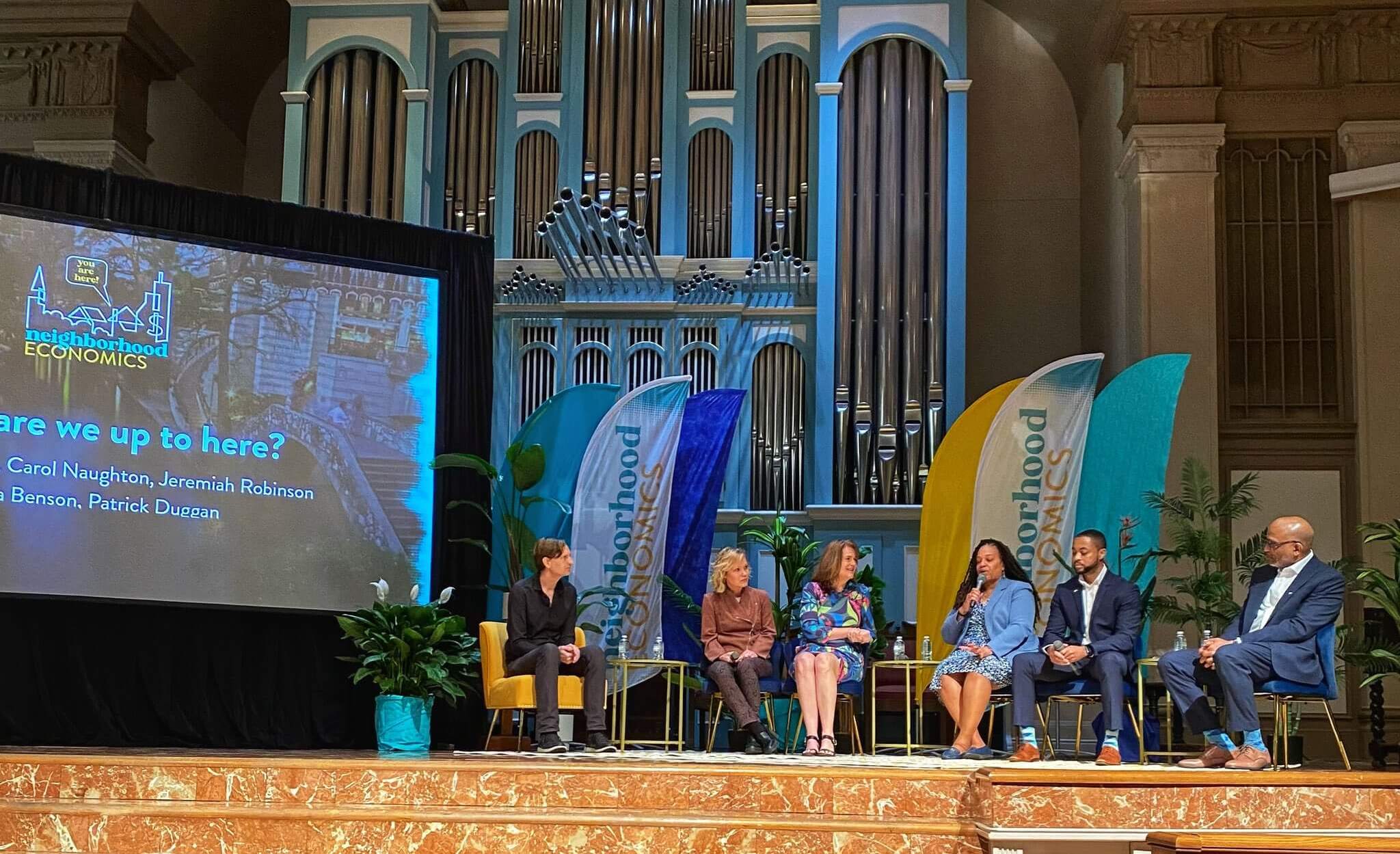

ImpactAlpha, Feb. 28 – The zip code in which a person grows up in America is more a determinant of their health than their DNA. That makes “neighborhoods a really important unit of change,” said Carol Naughton of Purpose Built Communities at Neighborhood Economics, the annual gathering of local economy investors and ecosystem builders.
Inside the historic Travis Park Church in downtown San Antonio, pastors, community organizers, business owners and local investors crafted a narrative of abundance and bottom-up reinvestment.
Churches aren’t in decline but are economic engines in their communities (UCC Church Building and Loan Fund’s Patrick Duggan). Asylum seekers are not a burden but a symbol of America’s promise (Dianne Garcia, pastor at San Antonio Mennonite Church). Ending discrimination in lending is an opportunity for financial growth for all (Neighborhood Economics’ Jeremiah Robinson).
“You are the actual health creators,” Douglas Jutte of Public Health Institute told local innovators in the room. “You should own it and talk about it.”
Wealth determinants
Just like there are social determinants of health, “there are social determinants of wealth,” said Ida Rademacher of the Aspen Institute, which last year released “The New Wealth Agenda” with a bold target: 10x the wealth of households of color.
Among the levers: Positive cash flow, debt resolution, wealth-building career pathways and homeownership. Rademacher is working with Partners in Equity, Local Code and Chicago TREND to expand wealth building strategies (see also, “Paths to inclusive wealth run through residential and commercial real estate”).
“We can demonstrate an iterative process to elevate opportunity in Black and brown communities,” said Wilson Lester of Partners in Equity, which is raising its second fund to help Black business owners buy the commercial properties in which they operate (see Lester on “Agents of Impact Call No. 50”).
Church economics
Religious congregations add over $400 billion annually to the American economy and are sitting on hundreds in billions in real estate assets. Yet up to 100,000 churches and other houses of worship are set to close in the next few years.
An alternative narrative is possible, says Patrick Duggan of UCC Church Building and Loan Fund, which trains up to 300 churches to finance and redevelop their real estate. “We can take our assets and rearrange them and do something different that’s missional and impactful” (see also, “Can Black churches spark a revival in Jackson, Mississippi?”).
Rather than shut down or sell out to speculators, one church sitting on five acres in San Jose, Calif. is working with the city to develop affordable housing in a city that needs it, explained Mark Sampson of Rooted Good, which helps churches develop new economic models.
Corridor model
Geographic focus. Participatory decision-making. Shared ownership. Blended capital stacks. And… speed.
Community leaders from Kensington Corridor Trust in Philadelphia, Innovation Works in Baltimore, Downtown Crenshaw in South LA, LocalCode in Kansas City, and Estar West in San Antonio aim to create “gentrification without displacement” with an emerging set of investment strategies in real estate and local businesses.
“We are not building power. The neighborhood already has power,” said Adriana Abizeda of the Kensington Corridor Trust. The citizen-governed trust, she says, channels that power to deliver “what the folks in that neighborhood want and need.”