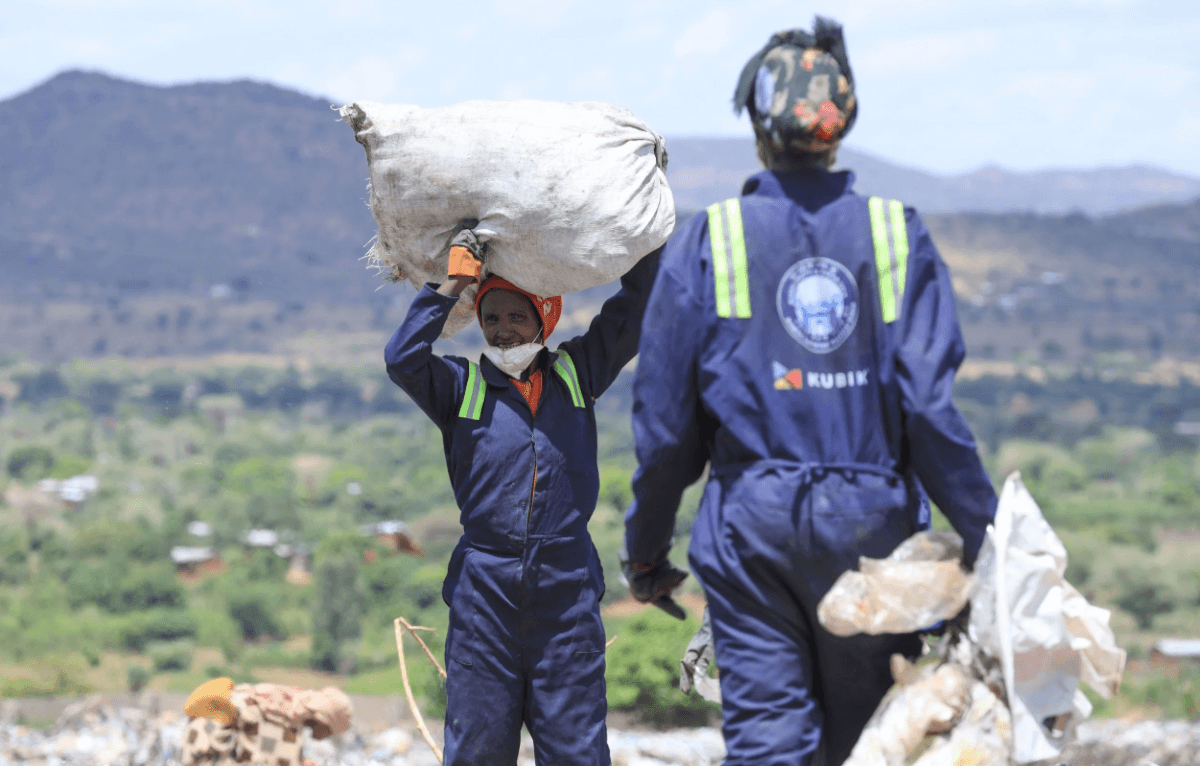

In Ethiopia, five-year old startup Kubik is converting up to 45 tons of hard-to-recycle plastics daily into affordable green building materials such as rubber bricks, beams and columns. It has raised $5 million to expand into new markets and directly source from informal waste collectors, with the goal of creating 10,000 jobs.
Kubik was helped along by Manufacturing Africa, a program of the UK government that provides technical assistance to small and growing green businesses in Ethiopia, Kenya, Nigeria, Rwanda, Senegal and Tanzania and Uganda.
Its Green Business Building accelerator has supported 46 such businesses working on aquaculture, agroprocessing, sustainable packaging, clean energy, waste management, biochar production and other climate-smart solutions. Depending on their size, stage and needs, these businesses will get training ranging from fundraising and investment readiness, to transaction facilitation support, financial modelling, market research and sizing and growth strategizing.
Along the way, Manufacturing Africa saw a funding gap for businesses that were too small for private equity yet struggled with misaligned collateral demands from commercial lenders.
For its next phase, Manufacturing Africa is launching the Forge Africa fund, a $200 million special purpose blended fund that leverages development financier funding and pension capital to cut checks of between $1 million to $5 million for green ventures stuck in that limbo. Manufacturing Africa is engaging domestic pension funds to ensure local currency availability. The fund is currently in the pipeline development stage and aims to begin deployment in the first quarter of 2027.
“We had been missing a real opportunity,” said Priti Prajapati of the UK’s Foreign, Commonwealth and Development Office, or FCDO, in Tanzania, which oversees the program. Small and earlier stage companies are “where most of the jobs are created.”
Her comments came at the Green Business Building Forum in Nairobi this week, a pan-African gathering hosted by Manufacturing Africa and its Green Business Building accelerator that drew 150 investors, startups and other leaders.
The goal was to connect green startups with investors and resources to help them succeed. Green manufacturing is seen as a growth sector that can create good jobs for Africa’s growing youth population.
Early-stage conundrum
Access to finance remains a challenge for green manufacturers. Equity is even harder.
Take clean cookstoves maker Burn Manufacturing. It launched in 2010 with $4 million in loans. It wouldn’t be until five years later that the Nairobi-based startup got its first equity investment, from Acumen.
Starting out with no equity, “was a really crazy thing to do,” Burn’s Peter Scott told attendees at the conference. “But back in the day, when I started in 2010, nobody wanted to fund clean cooking in Africa. They were like, ‘that never works. That’s stupid. Don’t do clean cooking. Get a real job.’”
Since then, Burn has sold more than 6.6 million electric and clean cookstoves, saving nearly 40 tons of wood and avoiding 68 million tons of carbon emissions. It’s also created 2,500 jobs.
“We’ve been able to do it through a lot of organic growth. Not necessarily because we were smart, but just because nobody really wanted to invest equity, for the longest time, into clean cooking,” Scott said.
Burn has raised around $233 million in grants, debt, equity and carbon finance, successfully navigating the early stage capital challenge that many green manufacturers face as they prove out their models.
Manufacturing Africa wants to help more promising green startups do the same.
“As funding shrinks, Manufacturing Africa is looking to provide an even more business-centric approach, allowing businesses greater agency in selecting the service providers to support their growth,” FCDO’s Tertia Bailey told ImpactAlpha. The program, she said, is exploring the use of “returnable grants and cost-sharing mechanisms to ensure businesses have skin in the game and that funds can go further in making an impact.”
Other startups that have participated in the Green Business Building accelerator include Senegal-based insect protein company NeoFarm, which raised $3 million for commercialization and research, and Nigeria-based Hinckley Associates, a battery recycling and re-manufacturers that went on to raise $4.5 million.
To date, Manufacturing Africa says it has mobilized up to £2 billion ($2.7 billion) into green manufacturing businesses. Most of the deal sizes have been in the £5 million ($6.7 million) to £25 million ($33.7 million) pound range.
FCDO’s Daniel Wilcox told conference goers that supporting early-stage business is an investment in supply chains and innovation.
In green industrialization in particular, betting on incumbents means making them more productive, Wilcox said in a panel session. In contrast, “You nurture small and medium-sized businesses in those sectors and they’ll bring innovation.”