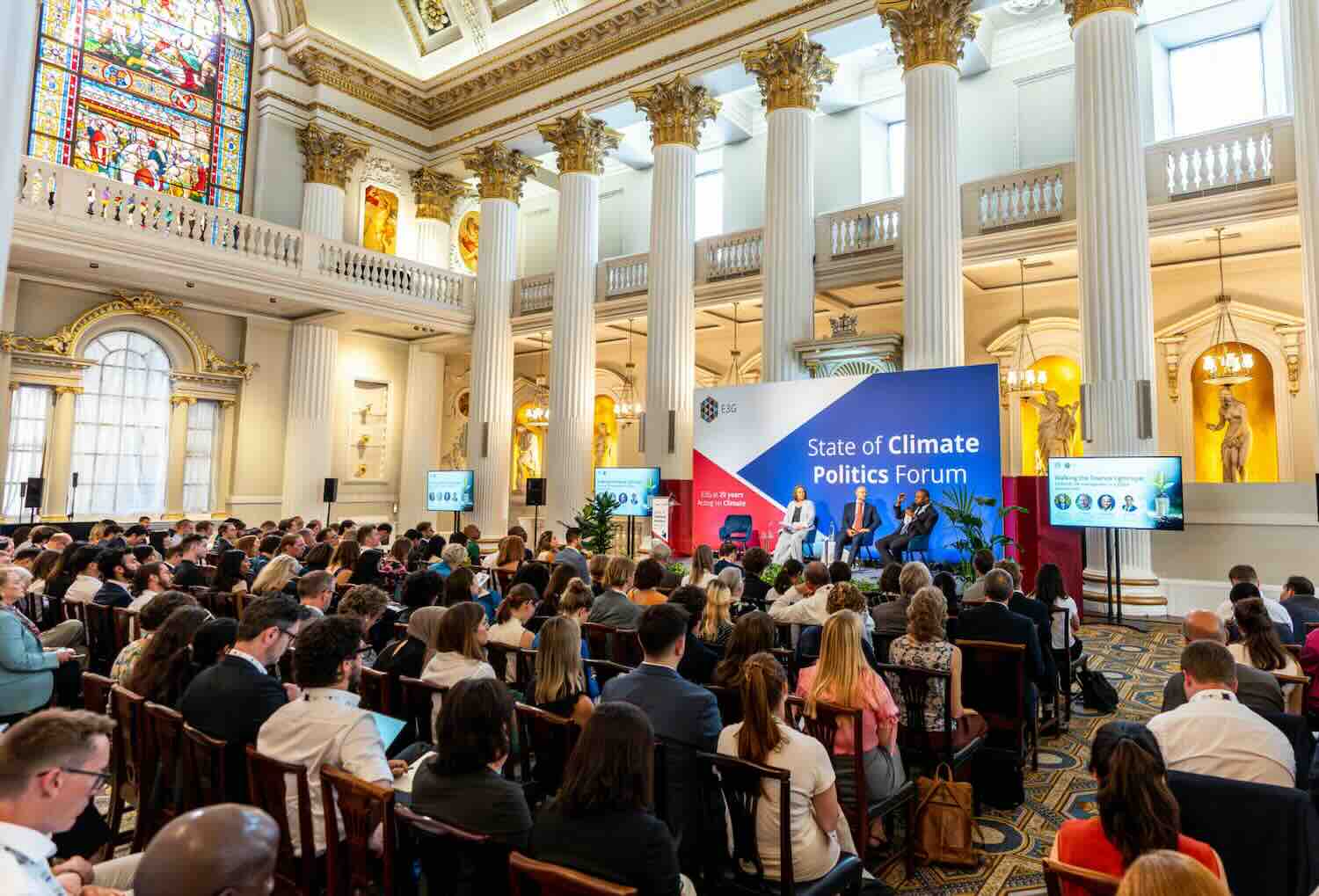

When all around you are losing theirs… the British keep calm and carrying on. The view from last week’s London Climate week was, dare I say it, quite hopeful. Very little was uttered about US President Donald Trump, or the global sense of unrest in which we find ourselves.
Now in its seventh year, London Climate Week was bigger, buzzier and more global than ever before — as the climate crowd looks beyond the now climate-unfriendly US. In other words, the perfect backdrop for the UK to demonstrate its bid for global climate leadership.
“Our mission is to make Britain a clean energy superpower,” declared UK Energy Secretary Ed Miliband. In the year since Labour took back the reins of UK power, it has reversed its predecessor’s climate-regressive policies, lifting an effective ban on onshore wind and vowing to double triple solar capacity and quadruple offshore wind power by 2030.
Ahead of Climate Week, the UK unveiled a £30 billion ($40.84 billion) green industrial strategy to drive investment in domestic green energy and related sectors. Like the US Inflation Reduction Act — the US landmark climate legislation now being dismantled by Trump — the strategy offers incentives to producers to create domestic supply chains that make the UK more resilient and create good local jobs.
The plan singles out wind power, nuclear fission and fusion energy, carbon capture and usage, hydrogen and heat pumps for investment. The goal: to be “the most attractive place in Europe to invest in clean energy industries.”
The UK is also doubling down on climate disclosure, and will mandate that large companies report on climate risks and impacts.
London mayor Sadiq Khan is also on board. He kicked off London Climate Action Week by announcing a £12 million Green Roots Fund to invest in local neighborhoods across London to make them greener and healthier, plus a Climate Finance Taskforce comprised of investors and stakeholders to help the City reach its Net Zero 2030 goals.
“This is a moment to show despite the US pulling out, all the other financial institutions are all in for aligning finance with the clean energy transition,” said Nick Maybe, founder of London Climate Action Week and co-founder and director of the environmental consulting firm E3G. “People see the opportunity.”
It don’t mean a thing, if you ain’t got that ka$-ching
The UK stance is refreshing as one-time climate leaders backpedal (hello, EU) or even actively work to increase emissions (the orange, coal-lover in the oval office).
“Everywhere we look in the so called ‘free world’ of the West, populism is triumphing over climate logic, or indeed economic logic, with hurdles put in the way of any kind of green technological progress and policies we fought so hard to secure this last decade going into reverse,” observes Mark Campanale of UK think tank Carbon Tracker.
As a center of finance and insurance, London fancies itself as the new global hub for tackling the climate crises. Indeed, climate solutions and innovation could, at least in theory, also help address the gaping wide hole that Brexit left in the UK’s finances, and which Labour has been struggling to fill ever since it was elected into office last year. (Not to mention the Tory government before it.)
The Office for Budget Responsibility has estimated that Brexit will shave 4% a year, or £100 billion, off the UK’s GDP. Equally critical, the Center of European Reform (CRE) estimates that investment in the country is 13% lower as a result of BREXIT.
Meanwhile, if the economy continues on its current trajectory, climate change is expected to cost the UK up to 3% or so of GDP by 2050 and over 7% by 2100, according to 2022 research from the Grantham Research Institute on Climate Change and the Environment at the London School of Economics.
Conversely, investment in the net-zero transition could cost the UK a maximum of 2% of GDP but lead to net GDP growth of 4%. The world needs to invest an average of $5.6 trillion each year from 2025 to 2030, in order to get on track for global net zero by 2050, estimates Bloomberg New Energy Finance.
“The new UK government has an opportunity to rebuild the United Kingdom’s reputation as a climate leader,” notes Climate Action Tracker. The group rated last year the UK’s goals as “insufficient;” it has not updated its assessment yet under prime minister Keir Starmer.
A big focus of London Climate Action Week was getting some of that capital flowing. I spotted and heard from plenty of institutional investors and their advisors throughout the week, including the Church of England Pension Board, NEST, AP2, CDPQ, British International Investment, and the Green Climate Fund.
And there was plenty of discussion of moving capital at scale. The Climate Policy Initiative for example, released its comprehensive Landscape of Climate Finance, which found that $1.9 trillion was invested in the sector in 2023, and likely more than $2 trillion by early 2024. With public investment down, the role of the private sector will become even more crucial, the group says.
Actual new investment commitments were lighter on the ground in London, especially from the private sector. David Atkin, the CEO of UN PRI, admitted that fundraising has been tough for ESG-focused managers, and encouraged asset allocators to incentives those fund managers that were doing a good job.
Institutional asset owners were keen to express their desire to invest in the clean energy transition, but only for projects that are already derisked and scaled. Meanwhile, there was lots of talk about “universal asset owners” and moving the whole economy along through shareholder engagement and working with businesses.
An inconvenient truth however, is that many shareholders don’t want companies making the long-term capex commitments that it likely takes to green their supply chains, or otherwise participate in the clean energy transition. Reuters BreakingViews’ Yawen Chen let the cat out of the bag at the start of the week when she told her colleague Threlfall that “public investors prefer double digit returns from oil and gas not single returns from renewables.” She added, “it’s hard for publicly listed companies like BP to transition.” They get pushback from shareholders. (That’s one reason the oil giant, which moved beyond petroleum before returning to it after oil and gas prices surged, is a takeover target).
The current market for venture investing also continues to be challenging. I did hear from one climate industry veteran that, given the bile being thrown at cleantech by the Trump administration, European and UK investors are currently far more interested in looking at opportunities in their own backyard than in Silicon Valley and the US more generally.
Fishing in a smaller pond, however, will generally require investors to accept lower returns, this entrepreneur observed. In part because the sheer amount of capital dedicated to European and UK venture continues to remain much smaller than in the US.
Despite the feel good vibes, “the UK has catching up to do,” Sightline Climate pointed out in its roundup of the week. UK electricity prices are the most expensive in Europe, it noted, up to five times higher than elsewhere — “a dealbreaker for clean fuels and electrified manufacturing.” Grid connection lags and permitting bottlenecks are also a challenge.
Climate crisis
That’s not the only buzzkill. The week after LCAW, Global Tipping Points, run by a group of climate scientists and supported by the Bezos Earth Foundation, held a conference at the University of Exeter. If London Climate Week was about wishful thinking and optimism in the face of gale-force headwinds, scientists in Exeter were confronting a “new kind of ghastly reality,” says Campanale of Carbon Tracker, who was at both events.
In Exeter, speakers such as Dr. Johan Rockstrom of the Potsdam Institute for Climate Impact Research and Prof Tim Lenton of the Global Systems Institute at the University of Exeter presented evidence that, as Campanale puts it, “all the warning signs in the planet are running red.” It’s not just that oceans are warming rapidly and that global temperatures continue to smash records. “These increases are not happening steadily as historical models suggested, but actually on steep upward curves,” Campanale shared with ImpactAlpha.
Campanale, who pioneered the concept of a carbon budget — the definitive limit to the greenhouse gasses the atmosphere can absorb before spinning out of control — says we are rapidly reaching that threshold. “The ‘heat domes’ sitting over much of the planet aren’t an unusual phenomenon, they are the new normal,” he says.
That kind of reality check may dampen some of the feel-good Climate Week vibes. But it also points to the imperative that is driving the UK and other climate leaders — in short supply though they may be — and underscores the stronger than ever business opportunity for climate investment.
“The investment community is still grasping at old ways of doing things – better disclosure/more formal transition plans/more standards, better data,” Campanale laments. “As if any of these, in themselves, will beat the nasty politics laid bare all around us.”
“How do we take some of the urgency that we saw at Exeter into the otherwise stodgy ‘it’s going to be fine’ narrative of very gentlemanly, very British, discussions we saw in London?” he asks.
Mother Nature may yet force our hand.