Congressional leaders in Washington DC are busy drawing up budget plans that eliminate clean energy incentives, reinforcing the sense that renewable energy has become hyper-partisan.
The on-the-ground reality in America tells a very different story.
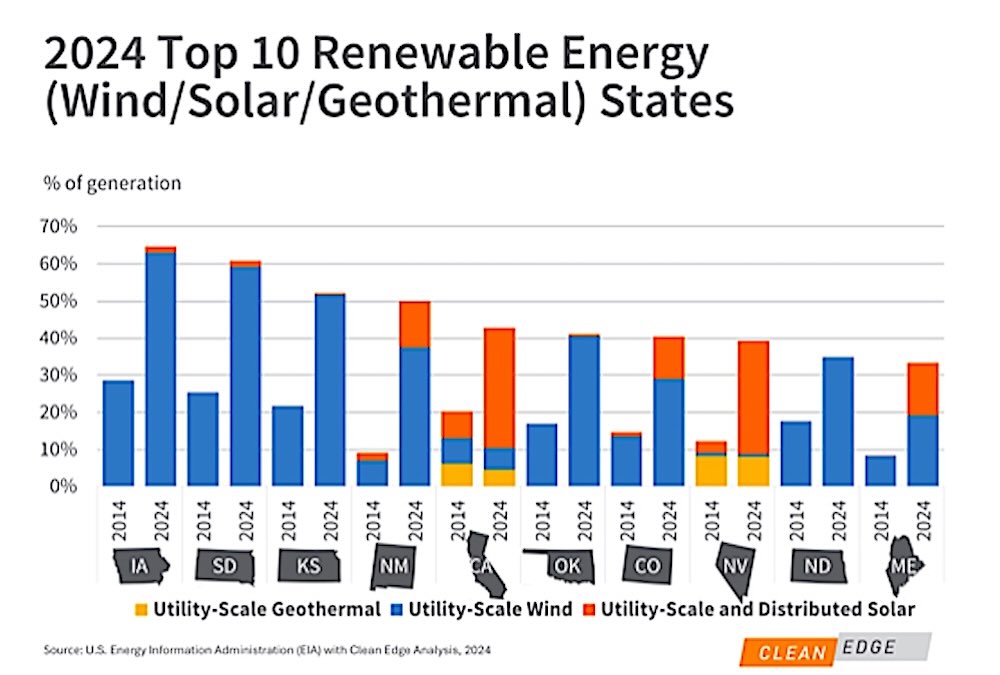
The solid-red Heartland states of Iowa, South Dakota, and Kansas lead the US in non-hydro clean energy generation as a share of their total generation. The three states generate more than half of their in-state electricity from clean energy sources, nearly all of it from wind power. Iowa and So. Dakota surpassed 60% clean energy for the first time in 2024. (When you’ve reached those levels, it’s well past time to retire the label of “alternative” energy).
Red states dominate the top 10 clean energy producers, with Oklahoma, Nevada, and North Dakota rounding out the list, along with four blue states – New Mexico, California, Colorado, and Maine.
From a pure capacity perspective, Texas and California are still the clean energy behemoths, by dint of their size. Texas generates more than three times the wind output of Iowa, for example, even though it represents a smaller share of the Lone Star State’s overall energy mix.
The counterintuitive results are the logical outcome of three factors: supportive state policies, overwhelming public support for clean energy, and increasingly, simple economics. Wind and solar are now the cheapest sources of new energy generation, and they’re fastest to deploy. Solar alone accounted for 81% of the new generation capacity added in the US last year.
“In an era where very little else is agreed upon, polling has shown consistent public support for renewables across both Democratic and Republican demographics,” says Ron Pernick of the clean energy research and indexing firm Clean Edge, which has tracked states’ clean energy generation since 2010.
In a 2024 Pew Research Center survey, 78% of adults in the US favored more solar power, and 72% supported more wind. Although there is a partisan gap, each energy source still commands a majority of Republican support (64% for solar, 56% for wind).
Clean Edge notes that new clean power additions across the country are shifting from wind to “the mass deployment of solar power and energy storage.” A record 50 gigawatts of utility-scale and distributed solar capacity came online in 2024, led by Texas, California, and Florida.
State-led
State policy leadership has been a key driver since the early days of clean energy. In 1983, Iowa enacted the nation’s very first renewable portfolio standard, or RPS – a state mandate to reach a specific share of electricity generation from renewable sources. Iowa’s wind power production has more than doubled over the past decade.
As of 2024, 29 states and the District of Columbia have RPS mandates in place. Virtually all large utilities and regional electric grid operators also have renewable targets. So, too, do a vast number of large corporations, which sign power purchase agreements for new wind and solar developments, mostly sited in rural, politically conservative areas.
“At the end of the day, these [targets] primarily come down to regional and economic decisions,” says Pernick.
California, the nation’s most populous state and the world’s fourth-largest economy, is by far the largest of the four states that have a 100% RPS mandate (California’s is by 2045). The mandate and a slew of other policies have helped boost the Golden State’s solar energy output, both utility-scale and distributed, to more than 30% of its total generation.
Of course, state policy can give, and it can take away. Clean energy progress in Texas, which has surpassed California in total renewables generation, is now threatened by two bills in the state legislature, one of which has already cleared the state Senate. If passed into law, they would require both existing and new solar and wind farms to install backup battery storage or natural gas-fired power to ensure continuous power. The cost of implementing that could cause dozens of operations and gigawatts of clean power to shut down.
For a state that generates nearly 30% of its power from wind and solar, and which ranks 14th in the country for clean energy generation, these policies would be a giant step backward.
“The retroactive nature of the bills is something that could send a chilling market signal to anybody wanting to do a long-term investment in Texas,” Walt Baum, CEO of Powering Texans, told the Houston Chronicle.