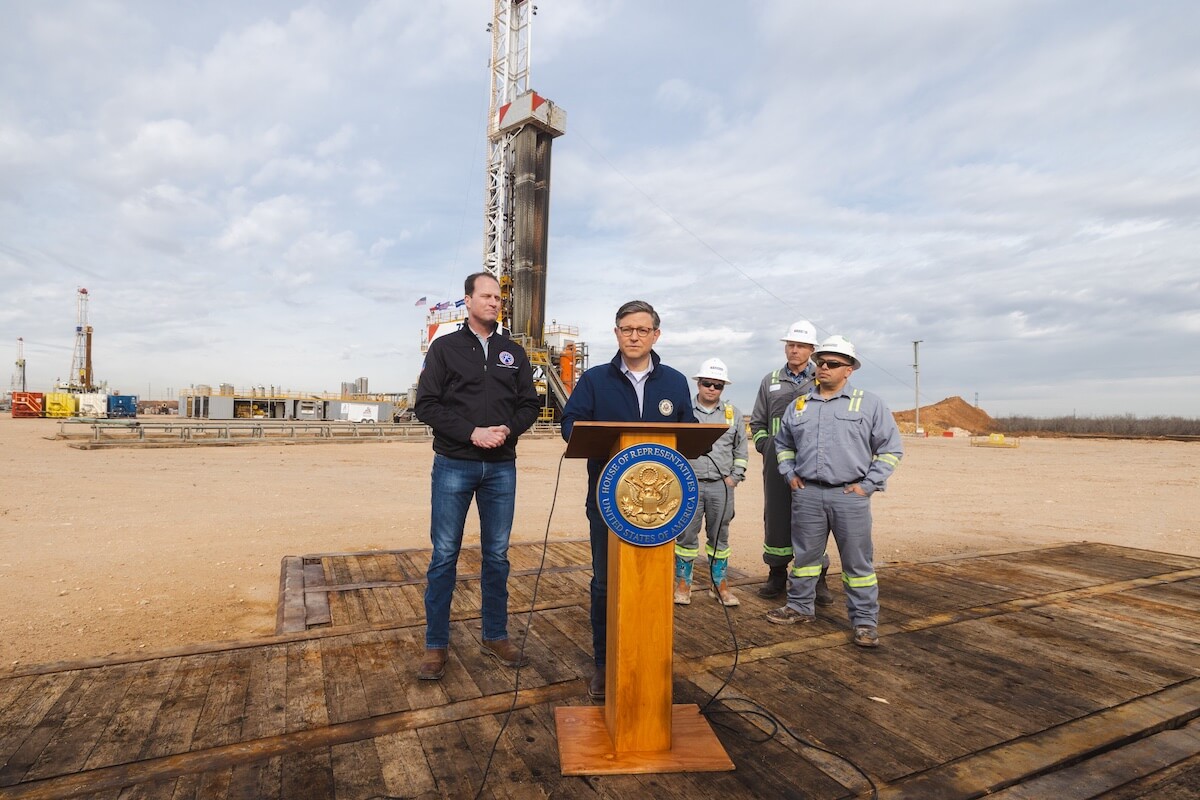

House Republicans kicked off “Energy Week” on Monday with a tour of a Texas oil rig and a promise to “protect American jobs.”
But the state’s ban on doing business with banks and asset managers that consider risks from environmental, social, and governance issues is having the opposite effect. Texas’ anti-ESG rules are costing the state hundreds of millions in lost economic activity, jobs and revenues.
State officials on Tuesday rescinded Blackrock’s financial management of $8.5 billion in Texas’ assets, citing a Texas law that prohibits state investment in companies that “boycott” energy companies and Blackrock’s “dominant and persistent leadership in the ESG movement.”
The state’s interventions in the market are costing Texans, according to a new study that evaluated the economic cost of only the state’s ban on municipal bond underwriters that incorporate ESG criteria, including Citi and Barclays.
Less competition, higher costs
The report from Austin-based TXP, Inc., commissioned by the Texas Association of Business Chambers of Commerce Foundation, is not the first to look at the impact of reducing competition among banks that municipalities hire to help them issue bonds. An earlier report, from a Wharton professor and a Chicago Fed researcher, showed borrowing costs were hundreds of millions of dollars higher because of the ban, as ImpactAlpha previously reported.
The new study applies those higher underwriting costs to a broader economic analysis. As the authors put it, “These funds are no longer available to be used for the standard functions of government, which in turn has economic implications.” Taking the direct impact of these increased costs, they came up with a measure of “total economic impact” — secondary, or “ripple” effects.
Those effects include $668.7 million in lost economic activity; $180.7 million in decreased annual earnings, with the biggest hit coming in the government sector; 3,034 fewer full-time, permanent jobs; and $37.1 million in losses to state and local tax revenue, the report says.
As the authors write, “in simple terms, when government attempts to mandate values (no matter what kind) to business, the market loses, and taxpayers bear the consequences.”
Ripple effect
The home-state backlash to “anti-woke” banks is notable because regional banks with municipal underwriting capabilities have a strong presence in Texas, and could presumably fill the void left by multinationals like Citi and Barclays, as previously reported.
“The legislation reflects a parochial view that is contrary to the state’s historical broad minded pro-business efforts as well as to the state’s stature as the world’s 8th largest economy,” Tom Doe of Municipal Market Analytics told ImpactAlpha. “Restricting competition denies access to financing capital.”
A resident of Austin, Doe is a frequent critic of the Texas state government’s denial of the effects of climate change.
“Texas citizens are made increasingly vulnerable when critical infrastructure is not efficiently and effectively modernized,” he says. The legislature’s efforts inhibit local economies, he added, “from not only adapting to the dynamics of a competitive global economy but also addressing the potential consequences caused by more frequent extraordinary extreme weather events.”
There are at least 20 states with laws banning banks that use ESG considerations from doing some kind of business with public entities. As conservative politicians ramp up these attacks against financial firms, many, including BlackRock, JP Morgan Asset Management, State Street and Pimco, have dropped out of the Climate Action 100+ network.