Brazil generates more than 80 million tons of urban waste annually, recycling only 8.3% – far below its estimated 30% potential. Two-thirds of that recycling happens outside public systems, relying instead on the invisible work of thousands of independent waste pickers.
Brazilian waste management lags significantly behind European and Asian practices. Portugal has eradicated landfills, and South Korea recycles 56.5% of its total waste and 97% of organic waste, driven by “pay-as-you-throw” policies and fines. To close the gap, Brazil urgently needs initiatives that connect social inclusion, clean technology, and new public service models. One of the most promising solutions comes from Brazil’s Northeast.
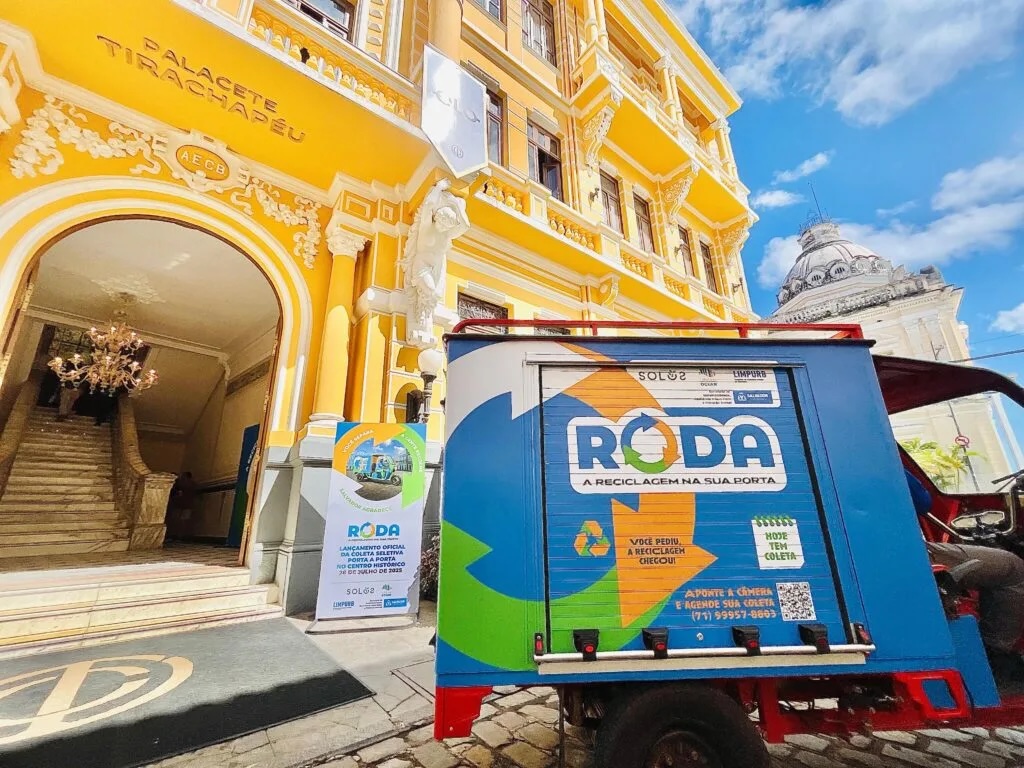
In Salvador, Bahia, where less than 2% of the city’s solid waste is recycled, the RODA project is piloting door-to-door collection of recyclables. Pickups are coordinated via online scheduling, and formally contracted waste picker cooperatives collect the recyclables using small electric vehicles. The project is cutting waste, formalizing labor, and reducing urban inequality.
Salvador’s experiment is turning an urgent environmental problem into a pathway for social equity, and it offers a model that other cities across Latin America can adopt.
Data-driven efficiency in the public sector
SOLOS, an impact startup specializing in circular economy solutions, is managing RODA in partnership with the Salvador city hall – through the Secretariat of Sustainability, Resilience, and Well-being and Animal Protection, the public company Limpurb, and the international Urban Ocean program of the Resilient Cities Network.
In my work at SOLOS, I have seen firsthand that RODA is much more than a logistics project. It emphasizes data-driven efficiency and social impact, tracking avoided emissions, income generated, and waste diverted from landfills. This type of intelligence applied to the public sector is rare. And it is what makes RODA scalable.
Starting at the edges of the system
According to Abrelpe, independent waste pickers collected over 4.5 million tons of recyclables in 2023, representing 67% of all recycling. This data shows that any solution in the sector must start at the edges of the system—where informal workers are located.
SOLOS recognized this from the beginning. The company has already collected more than 1,700 tons of waste in partnerships with major brands such as Ambev, iFood, Coca-Cola, Nubank, and Braskem. On this journey, it generated over R$ 6.6 million (about $1.2 million) in income for waste picker cooperatives, while reducing the environmental footprint of large events and supply chains.
Now, with RODA, SOLOS is transferring this knowledge to the public sector. The goal is not to replace public authorities, but to expand their operational capacity through impactful innovation.
Why this model is replicable
RODA’s modular design makes it adaptable to diverse contexts, such as medium-sized cities with little infrastructure, high-density urban areas, or tourist regions with seasonality in waste volume.
The key lies in the combination of four simple components:
- Digital scheduling accessible via WhatsApp, to facilitate resident participation
- An electric fleet, which reduces emissions and urban noise
- Hiring cooperatives with management and safety support
- Monitoring via impact indicators with open data
An impact agenda for attentive investors
Investors are only beginning to recognize the circular economy in Brazil as an opportunity. Yet the country already has solid foundations to integrate it into the portfolios of those seeking real impact. The RODA project offers important insights for impact investors and policymakers:
- Including waste pickers is not charity – it’s strategy. Waste pickers already drive most of the country’s recycling, and integrating them accelerates environmental gains and social returns.
- Low-tech tools can outperform expensive technology. WhatsApp is the project’s main communication channel, and it is accessible and effective for community mobilization.
- Impact measurement is not an add-on, it’s the engine. Each collection is registered, measured, and evaluated, informing better policy.
- Local governments are natural partners for impact innovation. Cities like Salvador are willing to test, co-create, and scale solutions that combine efficiency and equity.
Paths to expansion
While Salvador is the starting point, our goal is to bring the RODA model to other Brazilian cities – and eventually across Latin America. To get there, SOLOS is seeking partnerships with investors, public funds, and international agencies focused on the just transition, urban infrastructure, and climate adaptation.
According to Malcolm Robinson Campbell, Senior Program Manager at Resilient Cities Network, “Salvador is showing how to turn good ideas into action. RODA is exemplary in terms of inclusion, innovation, and impact potential. It can inspire a generation of urban solutions in the circular economy.”
Beyond recycling: A new urban logic
Brazil doesn’t just need to recycle more. It needs to change the logic of how waste is treated in cities: from an invisible cost to an urban asset.
The RODA project shows that it is possible to do this with intelligence, inclusion, and low carbon. It is the combination that the 21st century demands and that the impact economy is more than ready to support.
Saville Alves is the founder of Alimente Solos.