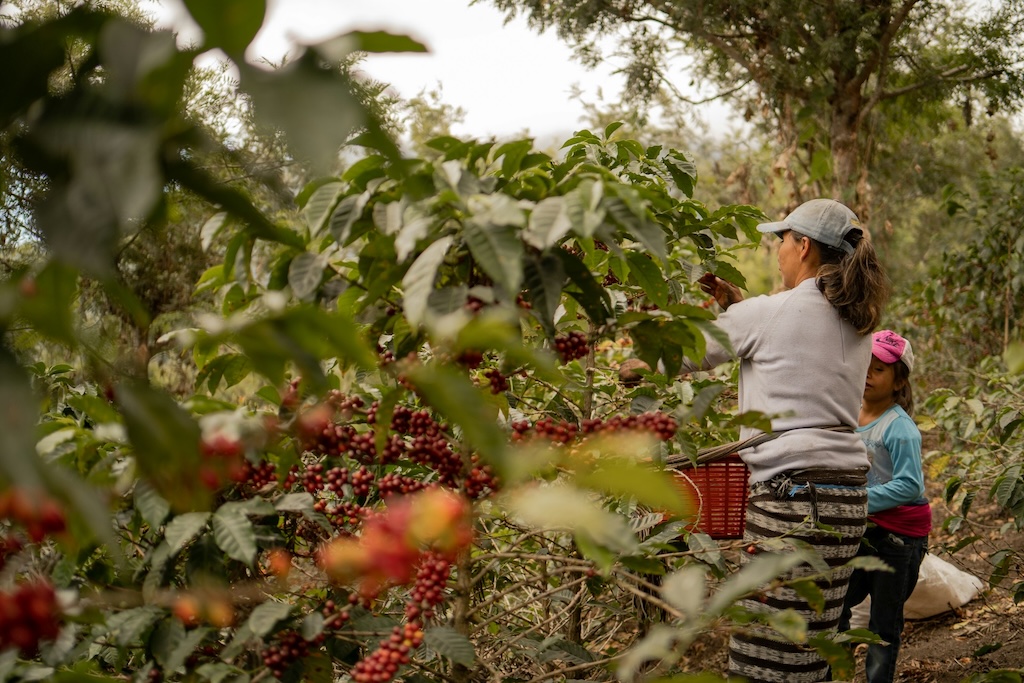
Robusta coffee, once relegated to instant blends, is gaining ground with farmers as climate change threatens yields from more preferred varieties. Farmers in Peru, Uganda and elsewhere are adding the hardy bean to their planting mix as a climate adaptation strategy, observes Elizabeth Teague of Root Capital, which is helping finance farmers’ climate transition.
“We’re seeing clients experiment with [whether] it can support resilience at the farm level and bring in an ancillary revenue stream at the business level,” she says.
Teague spoke to ImpactAlpha’s David Bank for an interview produced in collaboration with the Money + Meaning podcast to discuss the impact of climate change on farmers in Africa, Latin America and Southeast Asia.
Climate adaptation hasn’t always been core to Root Capital’s lending strategy, Teague recalls. The Cambridge, Mass. nonprofit started in 1999 to shift global finance flows to smallholder farmers and agribusinesses, which produce the majority of local food in emerging markets and are a critical driver of jobs in their local economies. The organization has loaned more than $2 billion to over 1,000 agricultural businesses in Africa, Asia and Latin America.
Root’s strategy focuses on cooperative and mid-sized enterprises, which are largely ignored by traditional finance but can individually deliver capital and support to hundreds and even thousands of farmers.
“We need local partners who are there with farmers, who can understand the risks,” says Teague.
A six-figure line of credit to a borrower cooperative in, say, Mexico or Peru, gets divided into $500 loans for individual farmers, giving them the cash to buy organic fertilizer or pay for more labor to implement biological pest controls. This lending approach allows Root to disburse larger loans while supporting farm-specific needs and growth plans, explains Teague.
Experimental finance
Over the years, Root Capital has experimented with different types of financing to reach deeper into underserved segments of the agriculture value chain. It has tested social impact incentives, a type of impact-linked financing, to fund smaller and riskier agribusinesses in Latin America. It has deliberately focused on financing women, and proven in the process that they’re less risky and often more profitable borrowers.
Its depth of knowledge about smallholder farming communities naturally led Root Capital into climate finance.
“Climate change is making farming riskier and more expensive,” says Teague. “We’re seeing that climate shifts are forcing farmers to invest more just to maintain their past yields.”
Root launched a Climate Resilience Roadmap in 2020 to figure out how to help farming communities adapt. It has provided fifty businesses with tailored “climate loans” to finance irrigation, organic fertilizer or agroforestry systems.
“These communities are very much prepared to act,” Teague says, but “their ability to take on debt financing for action is honestly lower than we expected.”
Many businesses are wary of borrowing without clear data on the returns associated with adopting climate-smart technologies or new farming methods, or without assurances that buyers will pay them if they switch to farming different varieties of crops.
Three pillars of farm resilience
Root is in the process of developing its next five-year strategy. Its climate resilience playbook is being built around three pillars: soils, crops and communities.
Healthy soils, says Teague, are the foundation. Compost and organic fertilizers boost soil productivity and water retention. Biochar can also sequester carbon and strengthen soil structure, she notes, but in many cases, “the more relevant, more actionable solution is compost.”
For crops, Root is keying in on crop diversification, like farmers that add Robusta coffee and cocoa plants to their traditional Arabica coffee farms. Integration of shade trees in agroforestry systems protect plants from extreme heat, conserve moisture and reduce erosion.
Root is partnering with irrigation system providers like SunCulture and Kickstart to run field trials in East Africa, gathering local data to identify how to make climate investments more bankable.
Scalability remains the sticking point: less than 1% of climate finance reaches smallholder farmers, according to Climate Policy Initiative. Conservative estimates suggest the sector needs at least seven times more capital than it receives.
Anyone who enjoys a morning cup of coffee, fresh bread or candy bar has a vested interest in making sure this happens.
“If we want to have global food systems in the future, if we want to have a good supply of coffee, of cocoa, of grains,” says Teague, “farmers will need to adopt new practices in order to maintain supplies in the future.”
This critical conversation is an example of the solutions-oriented topics that will be covered at SOCAP’s annual conference. We’re proud to partner with SOCAP25, taking place from October 27-29, in San Francisco. Meet us there: https://socapglobal.com/event-socap-25/