
The old New Yorker cartoon would be funny if it weren’t so heartbreakingly apt. Two lounging dinosaurs revisit what must be a recurring conversation: “All I’m saying is now is the time to develop a technology for deflecting an asteroid.”

The people of Kerr County and other parts of central Texas would certainly pony up the $1 million needed for the flood disaster early-warning system, if only they could rewind the clock to before last weekend’s deadly flash flooding. Texas Gov. Greg Abbott now says the state will pay for such systems if local governments can’t afford them. Even DOGE-sters and other budget-cutters would likely fill the vacant positions in the National Weather Service if they had another chance.
What other investments in prevention and resilience should we be making now, rather than wishing we had been prepared only after the inevitable surprises do indeed catch up with us? Investing $1 in adaptation can yield close to $11 over 10 years in avoided losses and other benefits, according to a recent World Resources Institute study.
Financing climate adaptation has become an urgent challenge as the planet’s climate blows past the 1.5 degree warming threshold beyond which life-threatening catastrophes are multiplying and natural systems that keep the Earth in balance are hitting tipping points.
From ocean currents that regulate temperatures to ice sheets that store vast amounts of carbon, critical natural systems are at risk of irreversible collapse. At a recent gathering in Exeter, England last month, climate scientists warned that these tipping points are approaching faster than climate models have predicted.
“All the warning signs in the planet are running red,” CarbonTracker’s Mark Campanale, who was at the Exeter conference, told ImpactAlpha.
The floods, said Andrew Dessler of the Texas Center for Extreme Weather at Texas A&M, are “exactly what the future is going to hold.”
Political failure
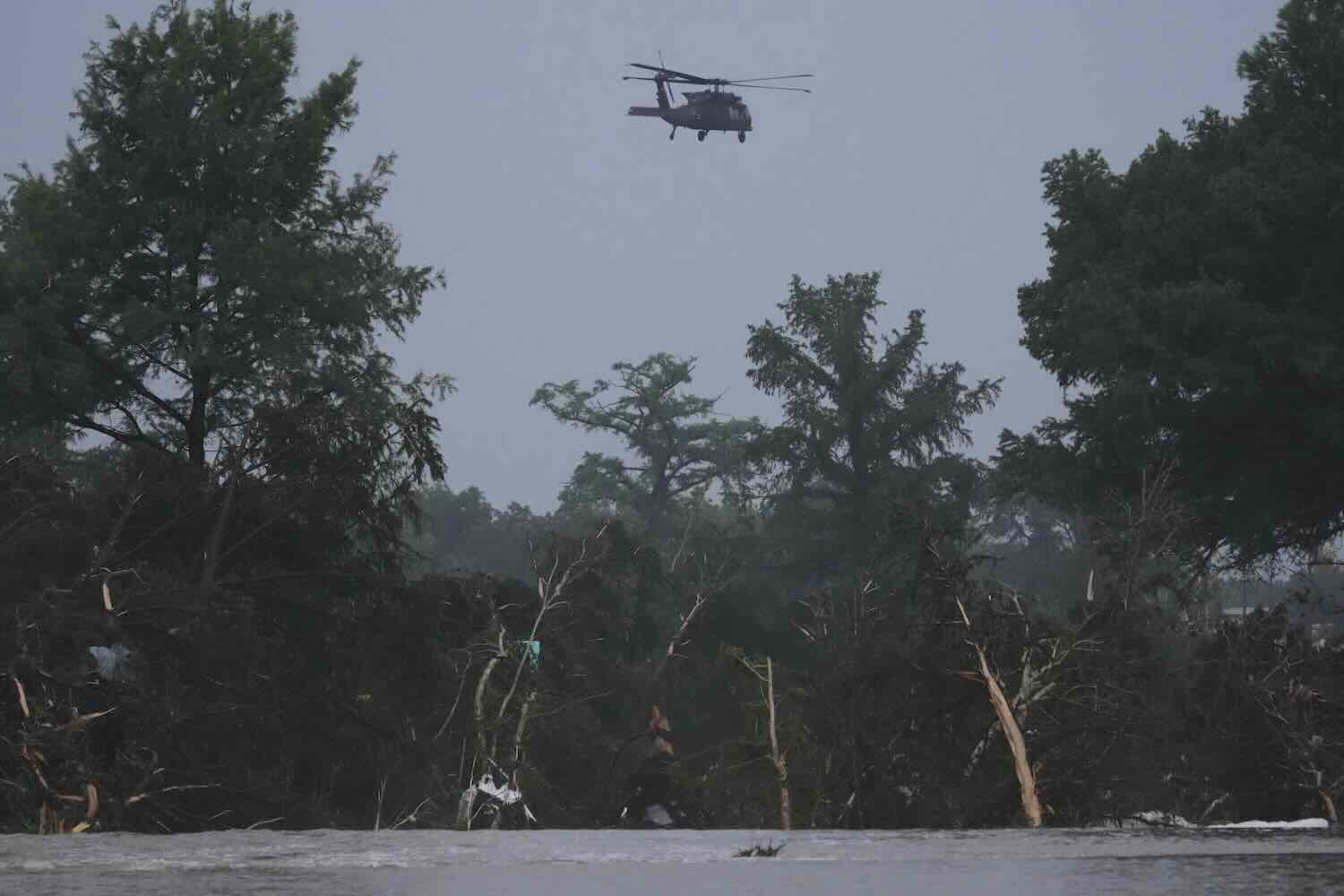
Of all the disasters that have afflicted the country in recent years, the floodwaters that took away so many young girls at their first sleepaway camp on the 4th of July feels especially heart-breaking. More than 87 people died in Kerr County, 27 of them children, when heavy rain caused the Guadeloupe River to abruptly rise by as much as 30 feet in less than an hour early Friday. At least another two dozen died due to floods in nearby counties. Gov. Abbott said on Tuesday that 161 people remain missing due to the flash floods in Kerr County.
Just hours after flooding began, Donald Trump signed into law a sprawling bill that seeks to kill off solar and wind energy and will set back efforts to contain global warming and the extreme weather it brings. Another program his administration has taken aim at, the $20 billion Greenhouse Gas Reduction Program, sought to establish a network of local green lenders who could fund projects that reduce pollution and build resilience in low-income and rural communities.
The ability to predict and respond to tragedies like the one in Texas is at risk from the cost cutting and downsizing efforts of the Trump administration that have left many agencies understaffed and overburdened. When the flooding hit Kerr County, a warning coordination meteorologist and science officer, among other roles, had been left vacant at a local National Weather Service office. Nationally, a third of National Weather Service forecasting stations lack a top meteorologist in charge, CNN reported in May.
Trump has also pledged to abolish the Federal Emergency Management Agency, or FEMA, and push those responsibilities to states, and to cut federal weather forecasting capacity. On Tuesday, the Supreme Court cleared the way for Trump to slash more federal jobs.
Climate-related and other disasters incur costs nonetheless. The US has spent nearly $1 trillion, or 3% of GDP, on disaster recovery and climate-related needs over the 12 months ending May 1, according to Bloomberg Intelligence.
“The latest episode of horrific flooding isn’t just about a natural disaster in one state,” former New York Mayor Michael Bloomberg wrote in an op-ed on his namesake news service. “It’s also about a political failure that’s been happening in states across the country, and most of all in Washington.”
Bipartisan support
In Kerr County, home to the Hill Country region known as Flash Flood Alley, officials in 2017 voted down an emergency response and early warning system due to cost. State legislators this year likewise rejected a statewide plan to improve Texas’ disaster response and provide grants to counties for communication equipment.
“I can tell you in hindsight, watching what it takes to deal with a disaster like this, my vote would probably be different now,” Wes Virdell, a Texas state representative from nearby Brady, Texas, told the Texas Tribune.
The same calculations made by Kerr County and Texas state officials play out around the globe, where climate adaptation has long taken a distant back seat even to climate mitigation efforts. Just $63 billion of global climate finance went to adaptation efforts in 2023, a 26% drop from the previous year, according to Climate Policy Initiative’s latest climate finance tally. That’s far short of the estimated $212 billion a year needed in adaptation and resilience spending by 2030 in emerging markets alone.
Arguments for carbon-free energy, and even green job creation and energy cost savings, have failed to sway Republicans, some of whom have referred to Biden-era programs as “the green new scam.” But adaptation and resilience may provide an opening for bipartisan support, especially as disasters multiply and swaths of the country become uninsurable.
When Homeland Security head Kristi Noem tried to cancel $882 million in grants under the Biden-era for Building Resilient Infrastructure and Communities program earlier this year, congressional Republicans objected.
Adaptation funding has traditionally been considered a government responsibility. But private investors are getting on board. What was once considered uninvestable has quickly grown to what Temasek and consulting firm BCG call “one of the defining markets of the future.” Climate adaptation and resilience is “the next trillion-dollar investment opportunity for private equity,” they say. SJF Ventures this year assembled a market map of tech solutions for climate adaptation and resilience.
“We need to be clear-eyed and practical about facing the accelerating complexity before us,” Jay Koh of adaptation-focused investment firm Lightsmith Group told ImpactAlpha. Tragedies such as the flooding in Texas, he says, “present an unavoidable opportunity: the chance to prepare, to innovate, and to invest before the next set of inevitable challenges.”
Lightsmith has invested in precision agriculture to enhance yields in the face of weather volatility, AI-enhanced vegetation management for wildfire risk, advanced insurance for supply chains, and rapid-response health diagnostics for mosquito-borne disease.
“No one is in favor of more extreme events,” Koh adds. “But there is a clear and present opportunity to invest in resilience to that inevitable risk and impact.”