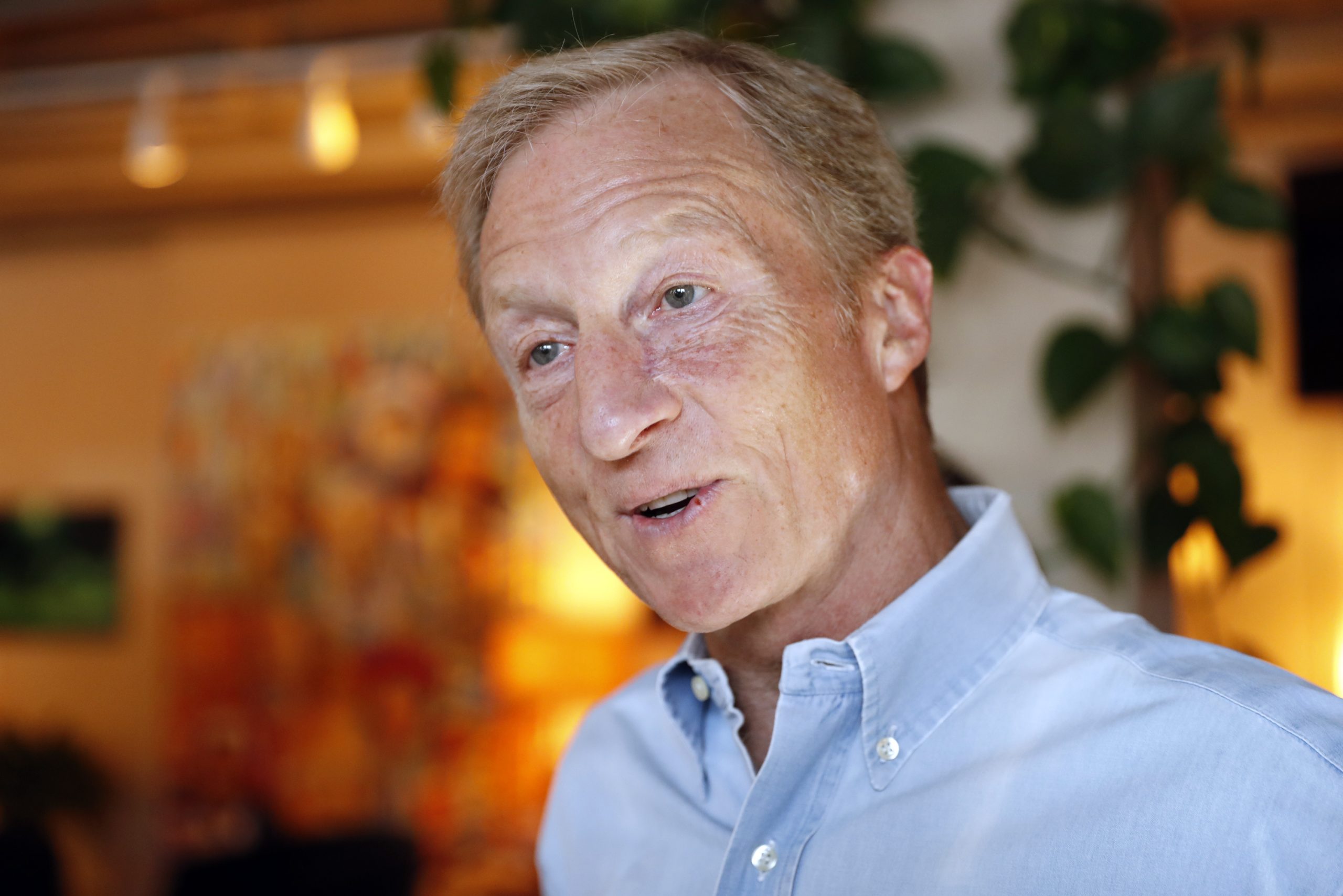

Climate champions have bemoaned the dismantling of US leadership on climate action. But at least one committed climate investor smells a buying opportunity.
“If there’s a big supplier of capital who has decided, ‘I’m out,’ that’s a good thing,” says Tom Steyer, co-executive chair of Galvanize Climate Solutions, which is taking equity stakes in early- and growth-stage companies and also investing in real estate and private-credit across the low-carbon transition.
“If you’re sitting there with cash, it’s an unequivocally good thing, because prices are going to be lower, there’s going to be less competition, and you’re going to get better returns,” Steyer told ImpactAlpha in a wide-ranging discussion last week in Galvanize’s San Francisco office.
Steyer made his fortune as the founder of Farallon Capital, a $20 billion asset manager for institutional investors known for taking high risks on distressed assets. He founded Galvanize with Katie Hall in 2021, after briefly running for president in 2020 (former Secretary of State John Kerry joined up last year). Last year, Steyer published “Cheaper, Faster, Better: How We’ll Win the Climate War.”
In 2023, Galvanize raised more than $1 billion for its inaugural Innovation+Expansion Fund. Its targeted $500 million Galvanize Real Estate fund has bought a number of properties with the aim of increasing their value by lowering their carbon footprints.
Excerpts from the conversation, (edited for clarity and length):
On climate finance
ImpactAlpha: Galvanize has recently hired Chris Creed from the Energy Department’s Loan Programs Office, which had built a large pipeline of climate solutions. Are there projects that have been orphaned by Trump administration policy changes that can be picked up by investors?
Steyer: I don’t honestly know, but I guess we’ll find out. If your question is, when the government moves out of financing things, and in particular, may want to get out of their existing contracts, is that an opportunity? It’s something to be explored.
A lot about investing is supply and demand. How badly do you want to sell? And so, when there’s less money around, prices go down. No money? Low price, good returns. Lots of money? High price, bad return. That’s just the way it goes. And so to the extent we see people coming out of an investment area – you have to ask, what’s the underlying, actual opportunity? – but, in general, that’s a good thing.
The old investing saw, which is not stupid, from Warren Buffett: Be greedy when people are fearful. Be fearful when people are greedy. And it’s really true.
If there’s a big supplier of capital who’s decided, ‘I’m out.’ OK, that’s a good thing. It’s a scary thing, because if you’re in that investment area, it may mean the prices go down, and so your existing portfolio takes a punch. But if you’re sitting there with cash, it’s an unequivocally good thing, because prices are going to be lower, there’s going to be less competition, and you’re going to get better returns.
ImpactAlpha: So it’s a buying opportunity?
Steyer: That’s just true. In terms of real estate, we think we’re doing something different in real estate, taking things to net zero. That’s what I would think of as traditional investing, alpha.
But there are these things called real estate funds, and the people who invest in real estate funds like to get cash back, and they have a time frame. And so they want you to send them money, not just send them dividend checks. There are a lot of people who are sitting there, who’ve been sitting there since they started raising rates in 2022, going like, “When are you going to send me some money?”
So those are people who kind of have to sell. They can delay, they can wait, they can hope, they can pick their spots, but they have to sell. So when you think about supply and demand, I’m saying there’s a certain set supply – ”we need to sell this over the next five years, three years, two years, one year.” Now, it’s just, “Sell it.”
You can look at that and go like, “Okay, good supply-demand situation, for a long period of time, if you’re sitting there with cash.”
ImpactAlpha: Which you guys have. Remind me whose money you’re managing in all this?
Steyer: We raise money the normal way people raise money.
ImpactAlpha: Like, where are the flows from?
Steyer: I don’t know what we’re saying about it. It’s not true that no one in the US is interested. Europe traditionally has been much more interested but, you’ve got to put that in a different context too, because there are a lot of other things going on.
I would say the Persian Gulf is interested in this stuff, for different reasons. Obviously, the Persian Gulf is a big supplier of fossil fuels. Also very interested in energy. Also very interested in the energy transition. They feel like we want to move our economies to the new place, and we’re going to keep selling fossil fuels and when that stops being a good thing, we don’t want to stop in our tracks, we want to have transitioned and have thought ahead and been smart about it.
And Singapore is always smart. They are very, very susceptible to rising seas. They’ve done a pretty amazing job over the last 65-70 years.
ImpactAlpha: Is Singapore to Saudi the green finance pipeline now? If you are trying to raise a green fund, is that the place to go?
Steyer: Those are people who have big sovereign wealth funds.
On making the business case
ImpactAlpha: What does leadership look like today?
Steyer: What leadership is going to look like is people who make these (climate transition solution) businesses work. You’re going to have to be normal capitalists. That’s why I wrote that book. Stop talking about all this stuff that no one cares about, and start talking about the stuff that people do care about, which is products that are disruptively good for customers and why that’s in their interest. Stop talking about yourself and start talking about the people you’re actually designing projects for.
ImpactAlpha: We’re collecting a “playbook for shared prosperity.” How is the energy transition going to help working people’s livelihoods and lower the cost of living?
Steyer: Cheaper, faster, better. You are going to be able to have cheaper electricity. You are going to have a much cheaper automobile, that is much cheaper to buy, much cheaper to maintain and much cheaper to fuel up. It is going to make your life better. You’re going to have the ability to do all kinds of things you weren’t able to do before. You’re going to be able to heat your house in a way that is so much smarter, so much cheaper and so much warmer or cooler than you could have. Magic, because there’s this technology that lets you do it. You don’t even have to be smart. It’s going to do it for you.
ImpactAlpha: So cheaper, faster, better is on track?
Steyer: It’s like renewable energy in Vietnam. They’re just buying it. Because it’s so cheap. Pakistan is an interesting country. Definitely below a percent, maybe as low as 1/10 of 1% of cumulative emissions, are from Pakistan. And 35 million people were made homeless by these terrible floods caused by global warming in Pakistan. Last year, Pakistan increased its electricity generation by 35% – all solar, in one year. Did they do that because they felt bad about us? No, they did it because they could do it and it was cheap.
So are people going to put in heat pumps because they think this is really going to be a good thing for other people? Or are they going to put in heat pumps because they’re going to say this is going to be a really efficient way to keep my home really warm so we don’t have to worry about it, and so we don’t heat the whole house and pay a huge electricity bill. We just heat the room that people are in when they’re in. It’s a great deal.
On carbon capture and sequestration
ImpactAlpha: At Elemental Impact’s event at Climate Week, you interviewed Aadith Moorthy of Boomitra, which this week issued its first “soil organic carbon” removal credits, sourced from smallholder farmers in India, apparently for a price in the high teens per ton of carbon (see, “Climate tech is counting on falling costs, rising demand to ride out the political storm”).
Steyer: If you think there’s 42 gigatons of emissions and we’re talking about a gigaton, that’s a big 2.5% of what we have to do as a globe. And we’re talking about doing it really cheap. He said $20s, $30s and $40s in terms of cost per ton, on a profitable basis, at gigaton scale.
You do 25 bucks times 40 gigatons and you can solve this whole problem for a trillion dollars, or a trillion and a half dollars a year. Really? That’s cheap.
We’re not seeing reductions in emissions, right? Because energy demand is growing. So even though we’re all in on renewable energy – 92% of new global energy generation is renewable – we’re not retiring fossil fuel plants. It’s The Great Addition instead of The Great Substitution.
My point is, a ton is a ton. Like, you sequester it, you reduce it. What’s the difference?
ImpactAlpha: Just sketch the cost curve and the price points and the time horizon.
Steyer: It’s basically 100 bucks a ton is $1 per gallon of gas. 25 bucks a ton is 25 cents per gallon of gas. $600 a ton is $6 per gallon of gas. At some level, we’re not doing it. It’s too expensive. So, you know, cheaper, better, faster. It’s like, okay, cheaper. And then the question is, how does it scale? Is it permanent? What are the second-order effects?
Basically, when you talk about the natural world generally, using photosynthesis to sequester has positive side effects. The side effects of this are much better agricultural yields. It’s sending money from the global north to the global south.
ImpactAlpha: And the co-benefits are high.
Steyer: I think we’ve seen that in most of the giant, global mechanical systems, the co-benefits are negative.. We’re seeing the ability to do this – combining nature and photosynthesis, with very high-tech, difficult technology – that we definitely can do. We’re seeing something that can really scale and has positive co-benefits, and can be very cheap. There’s adequate capital to scale things at those costs.
This is not a question about the capital. This is something where to scale, you’ve got to have buyers to sign. You’ve got to have people who are willing to buy a gigaton.
It’s a little bit of, if you could build it, they will come. It’s like, if you could really do $5 CO2 sequestration, that’s permanent. I believe you get every oil company in the world doing it, because they’d be like, “Okay, we’re good. For five cents a gallon, right? We can have a clean product. We’re done. We want that. That’s a great deal for us, because everything’s off our back, and we don’t have to talk about it anymore.”
It’s very cheap. I mean, they’re talking about doing stuff, if you go look at direct air capture, many, many, many, many multiples of that.
ImpactAlpha: The oil companies will buy just to get on the right side of the numbers?
Steyer: I mean, we do have a problem. We can say we don’t have a problem. We’ll see what the temperature is in April 2025, but for the last 20 out of the last 21 months, we’re over 1.5 degrees C. No one knows what 1.5 degrees C means, but I assume you do. And so that is a number that the climate scientists would have said was like less than a 1% probability two years ago.
ImpactAlpha: We’re past the worst case scenarios. But the temperature trends have been what they have been for a while, and it didn’t change the policy.
Steyer: But it really depends where you are. I think one of the big points here is, it’s a global problem. Americans seem to think that America is the world. It turns out we’re not the world. We’re 11% of emissions. We are actually reducing emissions. We will continue to reduce emissions. This story is going to be written in large part in Asia, in India and China.
ImpactAlpha: If you were looking to get rid of tons, there’s more tons, cheaper to get rid of over there.
Steyer: A ton is a ton.
Look, the American Petroleum Institute has come out for a carbon tax. ExxonMobil is in favor of a carbon tax. There have been bills introduced in 2025 by Republican senators calling for a carbon tax at the border as a way of charging China for their emissions when they come into the country.
I’m cheaper, faster, better. We’re winning the EV race. We’re winning the solar race. We’re winning the battery race. We, the people of the world and the United States. It’s just cheaper – 92% of new electricity generation is renewable because it’s cheaper. In the US, over 80% of new electricity is batteries plus solar, because it’s cheaper. And going to get a lot cheaper and a lot better in terms of duration for the batteries.
No one’s doing it to be nice. No one’s going to do it to be nice. But the truth is, it’s winning already with no cost for carbon. We’re winning without any cost for polluting. Pollution is free – It shouldn’t be free.
On new opportunities to watch
ImpactAlpha: You were kind of an early adopter on impeachment in the first Trump administration.
Steyer: It’s hard to see a time when the US stock market has been terrible, the US dollar has been creamed and rates have gone up. They’re all bad. How is this going? From an economic standpoint, it’s hard to claim that the dollar getting creamed, rates going up, stock market going down a lot, is like a measure of success. Obviously, people are very concerned. The markets are very concerned about understanding where we’re going and believing that where we’re going is smart. Yes, that’s quite apparent.
ImpactAlpha: And the policy reversals on climate are just a sidelight, a distraction?
The way the United States has succeeded is by winning, in a competition around the world where people vote with their dollars. Honestly, I’m not sure that there’s any other way for us to win. It’s never worked to try and force people to do the old technology. How much do you want to pay me to watch black and white TV? How much do you want to pay me to still use whale blubber? How much do you want to pay me? Because that’s ridiculous.
ImpactAlpha: Lightning round: Two or three more trends to watch.
Steyer: Looking at the ability to use real-time information to make the existing infrastructure better is really, really important because in the United States, the truth is, it takes a long time to build new stuff.
ImpactAlpha: So sensors, controllers, analytics?
Steyer: AI. Think about the grid. The grid is 31.8% efficient. There’s no reason that’s true, other than we do stuff that’s not smart. Could we be smarter about that? Yeah, we’d have to use a lot of real-time information to make that work much faster. The example I use is, there was a big Midwest utility that needed to upgrade their grid by 50%. And they did it using sensors and software at $48,000 a mile. To rebuild would have cost $600,000 a mile – 12x – and by the way, would have taken a long time. And you’d have had to shut down the grid as you rebuilt it.
You know, if the answer to the 21st century problem is, let’s do the 20th century thing, just better and bigger. I don’t think that’s gonna get done in time. People do not realize how important information, real-time information, is going to be to solving these problems.
What else am I really excited about? We are going to redo manufacturing. We are going to end up with circular manufacturing. We can do it, definitely, in the United States. It is not going to be on an assembly line devised by Henry Ford in 1908. We’re going to do it differently. We’re going to move to digital manufacturing, not analog manufacturing.
It’s going to be better, including cheaper, faster – better. We’re going to have to recycle stuff. We’re going to have to have circular manufacturing. We have to break stuff down and reuse it, yeah, cheaply, and think about it before we build the first thing. What is the new material we’re going to use? “Well, we’re going to use the same material they used in the Bronze Age.”
No, no, we’re not. Not going to be fossil fuels. Not going to be, “Let’s do the 20th century all over again.”
ImpactAlpha: Still having fun?
Steyer: I’m doing exactly what I want to be doing.