Opportunity Zones. Community investing. And affordable housing tax credits.
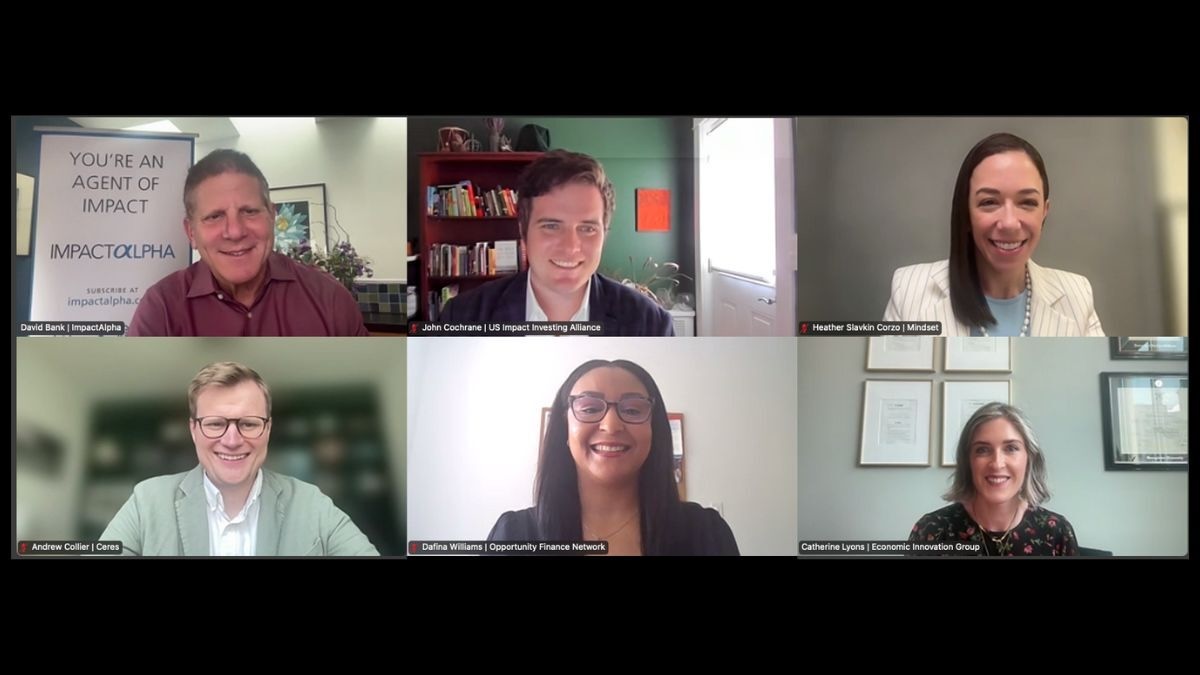
Amid the political headwinds and pushback, impact investors see opportunity for bipartisan action on common sense solutions that support broad-based prosperity. “Quick wins are not small wins—they’re essential building blocks,” said John Cochrane of the US Impact Investing Alliance, which co-hosted ImpactAlpha’s Call No. 72 “Opportunities for policy action and investing in shared prosperity.”
Headlines may focus on setbacks, but there are plenty of wins to build upon, including in the “Big Beautiful Bill” nearing resolution in Congress. One example: Opportunity Zones, a policy enacted in the first Trump administration that offers private investors tax breaks for investing in real estate or small businesses in economically challenged areas.
Both the House and Senate included OZs in their versions of the reconciliation bill, noted Catherine Lyons of the Economic Innovation Group, which has championed Opportunity Zones from the start. An “OZ 2.0” would improve upon the original law with better geographic targeting, mandated reporting, and a 10-year map redesignation starting in 2027.
Since 2019, OZs have funneled nearly $100 billion into over 5,600 communities and spurred the development of 350,000 housing units. The tax incentives “effectively doubled the amount of new housing supply in designated areas in five years,” Lyons said.
Unlikely allies
Dafina Williams of the Opportunity Finance Network highlighted the bipartisan resilience of community development financial institutions, or CDFIs. After Trump targeted federal programs supporting CDFIs, Republican and Democratic leaders rallied to their defense, reaffirming their role in supporting local businesses, job growth and wealth creation. The groundwork was laid by decades of advocacy by CDFIs and their partners to build trusted relationships.
“Community investing continues to be a priority for a lot of lawmakers, and it continues to have bipartisan support,” said Williams, noting that some 28 senators, ranging from liberal to deeply conservative, are part of the CDFI caucus. “Access to economic opportunity isn’t partisan.”
Another piece of the reconciliation bill calls for a $5 billion permanent expansion of the New Markets Tax Credit, a jump from the historic $3.5 billion, as well as key reforms to the Low-Income Housing Tax Credit that could unleash over a million new housing units. Even the anti-ESG campaigns from Republican states have rallied opposition from surprising quarters. “These bills really are anti-free market, and because of that, they allow unlikely coalitions to develop,” said Andrew Collier of Ceres, which has been organizing a “Freedom to Invest” campaign. Those coalitions have included bankers and unions, climate groups and conservatives.
In 2024 alone, he noted, 106 restrictive bills were introduced, but just a handful passed. “We are beating back legislation by bringing about the economic case, the business case and the investor case,” he said.
And climate disclosure bills in New York, New Jersey, and Oregon could signal a path to a de facto national standard, even if the Securities and Exchange Commission lags behind.
Laying the groundwork
Still, there are real challenges. “We have to be playing both defense and offense,” Cochrane said.
Climate investors have been mobilizing to defend the Biden-era tax tax credits meant to shore up domestic production of clean energy, EVs, batteries and a host of next-generation technologies. The Senate and House are battling over timelines for phasing out such incentives. There is still time to sway the outcome. “If you care about these issues, call your members of Congress now,” urged Heather Slavkin Corzo of bipartisan public policy firm Mindset, and the erstwhile policy director for former SEC chair Gary Gensler.
For now, it’s a mixed bag. Incentives for solar and wind will end starting in 2028, but other incentives for nuclear, hydropower and geothermal wouldn’t be phased out for another decade.
In addition to quick wins that build on bipartisan issues, policy leaders stressed the need to lay the groundwork for transformative progress in the future, and to communicate the kitchen table benefits of their policies, as CDFI and OZ advocates have done. “We need more programs that are like that, that provide tangible benefits to local communities,” said Corzo.
“This political moment that we are experiencing right now is not going to last forever,” she reminded attendees. Many of today’s leaders working in the wings will be in control of policymaking in the future. “This is the time to start developing the policy initiatives that you want to see those folks implement when they have the opportunity,” she added, “because when they come in, they are going to hit the ground running.”