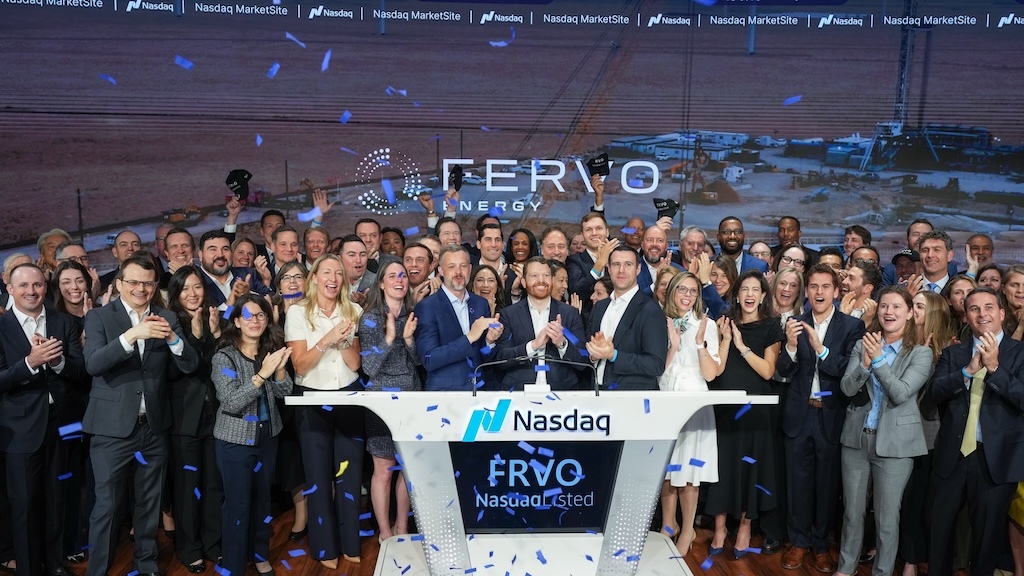

When the co-founders of Fervo Energy rang the opening bell on the Nasdaq stock exchange on May 13, clean energy investors had a moment worth savoring.
Fervo Energy raised $1.89 billion in an upsized and oversubscribed IPO, its shares popped 33% on the first day of trading. The company’s valuation crossed $10 billion, making it the biggest clean energy public offering in Wall Street history.
This was a good news story at a time when demand shocks from AI data centers and supply shocks from the ongoing conflict in the Middle East have left too many Americans paying too much for unreliable energy services.
Producing the next Fervo requires understanding the journey the Houston-based geothermal company took to its initial public offering and the crucial role played by a range of investors that are committed to financing transformational energy services.
A spectacular IPO is like a Michelin three-star meal. Its effortless and complete appearance masks what you don’t see: the frantic kitchen, the years of experimentation and frustration, the supply chains it took to get the ingredients to the table.
Put a rig on it
Fervo repurposes fracking technology developed by the oil and gas industry to unlock geothermal energy at commercial scale. Geothermal can deliver carbon-free power that runs continuously, around the clock, regardless of weather. Fervo’s founder and CEO Tim Latimer believes geothermal could eventually supply up to 20% of US electricity demand.
Over a decade ago, Latimer was working as a drilling engineer in the shale oil fields of south Texas when he became convinced fracking, or horizontal drilling, was going to revolutionize geothermal energy production. Only later did he discover a 1974 paper from a scientist at what is now Los Alamos National Laboratory describing exactly this approach.
Despite the established science behind the idea, his mining and oil and gas employer wasn’t interested, nor were the geothermal companies he cold called.
New technologies typically face two archetypal barriers to accessing financing. The first-of-a-kind problem: not a lack of ideas or research, but a lack of capital willing to move projects from paper to practice. Many high potential energy innovations face this “FOAK” risk — the uncertainty that comes with being the first commercial deployment of a new technology.
Even initially proven technologies can fall into a second challenge to finance the “Valley of Death,” the long, underfunded stretch between early validation and bankable scale, when grants have run out and commercial investors aren’t yet ready to step in.
To overcome these challenges, Fervo gathered a wide range of funding. It received two early grants of more than $10 million from ARPA-E, the Department of Energy program modeled on the legendary DARPA program whose early-stage bets on computing and networking helped usher in the modern venture capital industry. Like DARPA, ARPA-E is designed to go where the market won’t yet go, funding high-risk, high-potential technologies before private investors are ready to move. Those grants helped Fervo validate its core technology and attract the private capital that followed.
Elemental Impact, a nonprofit investor backed substantially by Laurene Powell Jobs’ Emerson Collective, made its initial equity investment in Fervo in 2020. Elemental’s model uses philanthropic backing to make equity investments that commercial investors won’t yet take on, precisely to help companies overcome the FOAK stage. Elemental worked with Latimer’s team to identify local suppliers, accelerating Fervo’s development timeline.
Breakthrough Energy Ventures, the climate investment fund Bill Gates built to back capital-intensive technologies with long time horizons, was another early backer. These were investors willing to underwrite technical and execution risk long before geothermal was commercially proven at scale.
Then came Capricorn Investment Group, which entered at the pivotal moment when Fervo needed to bridge from early validation to commercial viability. Capricorn, an asset manager with deep expertise in climate and technology investing, led Fervo’s $28 million Series B in April 2021, and later led the corporate equity portion of a $255 million financing to support Cape Station, Fervo’s scaled-up facility in Utah.
“Capricorn believed in us before geothermal was cool,” Latimer said. “They understood not just the climate case but the business case.”
Fervo’s Cape Station project also received a $25 million grant from the Department of Energy’s Enhanced Geothermal Systems Pilot Demonstrations program, the single largest award from the DOE’s Geothermal Technologies Office.
By the time Fervo raised its $462 million Series E in 2025, traditional infrastructure investors and strategic corporates like Google were ready to step in.
Catalytic capital
Fervo is a textbook example of what it will take to expand affordable, reliable energy services for Americans. Even before the latest surge in energy prices and demand, some one in four US households were energy burdened, paying more than 6% of their income for energy. Solving that problem at scale will require not just more Fervos, but more of everything: advanced nuclear, long-duration storage, grid-enhancing hardware and software, and energy efficiency solutions that lower bills for families least able to absorb them. Each of these has its own FOAK problem. Each will need to cross its own Valley of Death.
A growing group of experienced, committed investors and fund managers have organized to create the capital bridges to bring other companies along. The nonprofit CREO Syndicate brings together families, foundations, and individuals to share diligence, coordinate learning, and co-invest selectively in climate and energy solutions. The Catalytic Capital Consortium, originally founded by MacArthur Foundation, The Rockefeller Foundation, and the Omidyar Network, now includes 11 members committed to making exactly the kinds of investments that can support companies with financing that mainstream markets will not, including in clean energy.
SJF Ventures, a Durham-based firm founded in 1999, has spent decades building bridges across energy innovation. It led Community Energy’s Series A in 2010, helping prove that 100-megawatt-scale solar projects could be financed across multiple states.
For the hardest FOAK projects, which may be too risky even for mission-driven venture investors, Prime Coalition and Elemental have developed tools to bridge the gap from grant to commercial finance. Prime, founded in 2014, converts philanthropic dollars into for-profit equity investments in industrial startups, then recycles returns into new climate investments.
Elemental developed the D-SAFE to finance the soft costs that stall climate projects before traditional investors can step in, pegging investment to project-level development milestones rather than product development.
Scaling up nuclear power faces a different financing challenge – predevelopment costs – that shares similar dynamics to the FOAK problem. While large-scale reactors are a long-proven technology, the often decades-long process of project development and permitting creates soft costs traditional lenders won’t touch. Charles Oppenheimer, grandson of Robert J. Oppenheimer of Manhattan Project fame, has launched Oppenheimer Energy as a project-development company to aggregate capital from investors willing to remove the project finance bottleneck to ensure increased clean energy production.
The All Aboard Coalition, a venture capital collaborative made up of Breakthrough Energy Ventures, Khosla Ventures and a dozen other climate tech VCs, backs ready-to-scale startups after three or more members have invested. In January, it invested $115 million in Salt Lake City-based Zanskar, which uses AI to identify promising geothermal sites and speed development.
Let’s get cooking
The FOAK problem and the Valley of Death are structural features of new energy production. Fervo needed a specific sequence of investors before the IPO became possible, and the next Fervo will need the same. So will the one after that.
Foundations, family offices, and political leaders committed to energy security and affordability are well-positioned to step in, funding grant pools like ARPA-E and early philanthropic vehicles like Prime and Elemental, and investing in commercial funds like Capricorn and SJF, or both. If you don’t have your own foundation or the ability to make multi-million dollar investments, you can deposit your savings with a green bank or community lender that makes loans for clean energy production.
The founders are there. The technologies are there. Some have been waiting since 1974. What they need now are investors willing to staff the kitchen before the restaurant is full, before the reviews are in, before anyone knows it’s going to be a three-star meal. It’s time to roll up our sleeves and get cooking.
_______________________________________________________________
ImpactAlpha contributing editor Antony Bugg-Levine is the author of “Investing in America: Expanding Access to Finance to Solve Our Shared Challenges.”