Last February, a key source of capital in Africa – USAID – disappeared virtually overnight. This February, the start of a new war in the Middle East disrupted the flow of two key imports for the continent: fuel and fertilizer.
The war’s ripple effects are immediately painful for many African economies, but they’re also reaffirming strategic efforts to do, make and invest more locally.
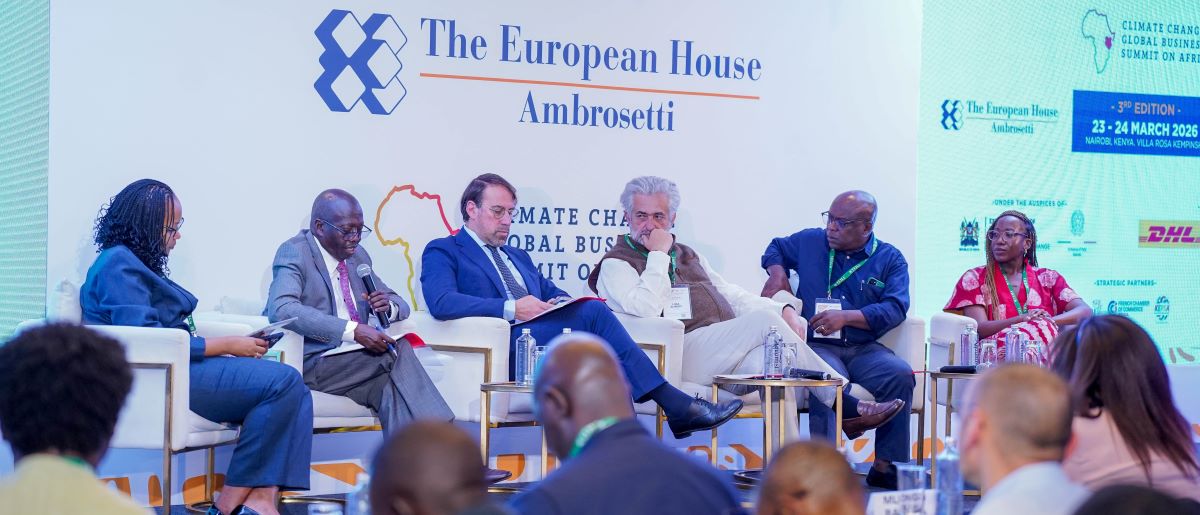
“Strategic autonomy is going to be the word going forward, everyone will be looking at, ‘What can I do domestically to reduce my exposure?’” Daniel Wetzel of the International Energy Agency told ImpactAlpha on the sidelines of last week’s Climate Change Global Business Summit on Africa in Nairobi.
Building up renewable energy capacity is an obvious move, and one where many African economies already have a strategic advantage. More than 600 million Africans – about half of the continent’s total population – lack reliable access to electricity. Solar, hydropower and other renewable sources are powering much of Africa’s expansion of energy services and capacity.
The government of Burundi, for example, is partnering with private partners like Anzana Electric Group (formerly Virunga Power) to tap hydro and other renewable sources of power available in the country and distribute them throughout rural communities.
Renewable energy assets can be localized, unlike oil and other fossil fuels.
“What these geopolitical disruptions prove to many people is that you still need to have renewable energy, because that’s typically independently managed,” said Catalyst Fund’s Olúwatóyìn Emmanuel-Olubake.
Catalyst Fund is looking to support sustainable business models for distributed solar energy, like solar-powered cold-chains, energy storage and other productive use assets through its climate resilience fund. It has already invested in more than two dozen startups, including NoorNation, an Egyptian startup that sells solar-powered desalination and irrigation systems.
More than a decade of work by entrepreneurs and early investors in Africa’s off-grid solar sector has yielded plenty of lessons from which to build better, more scalable businesses. Models with the greatest odds of success, Emmanuel-Olubake says, will be designed and built around local realities and consumer preferences.
Acumen is one of the organizations stepping up even as others pull back, with its Hardest to Reach fund, a blended finance initiative for off-grid solar companies in frontier economies. Backed by the Green Climate Fund, South Korea-based Shinhan Bank, the Soros Economic Development Fund and others, the fund hit its $250 million target last year. The capital is deployed through two vehicles that offer impact-linked loans and receivables-backed financing, alongside a mix of equity, debt and grants.
Sustainable agriculture
Another key focus for Africa’s “strategic autonomy” is fertilizer for farms. Africa largely imports fertilizer, and farmers were already hard hit by price spikes caused when Russia invaded Ukraine. Now, stalled shipments of urea, a key fertilizer ingredient, through the Strait of Hormuz have ratcheted up prices again.
“How food is produced right now in the world is between two extremes: the subsistence agriculture that you see with smallholder farmers in Africa, and industrialized agriculture. Neither of them is sustainable anymore. We need to find new ways to address food production,” observed Dario Cipolla of the Italian Agency for Development Cooperation.
The pain of soaring input costs presents an opportunity to shift to more sustainable growing systems, he added. “If the prices increase, farmers can try to apply different techniques. Regenerative agriculture is one of them.”
African countries have been getting support in transitioning to regenerative agriculture from Italy, which two years ago launched the €5.5 billion Mattei Plan to support climate-smart infrastructure, agriculture and off-grid energy in Africa. Through the initiative, Italy backed a $210 million investment in a biofuels venture in Kenya linked to Italian energy company Eni. Eni Biofuel is using the capital to build up new production plants and plant castor and cotton on degraded land as a source of feedstock.
In another deal, Italian agro-industrial group Bonifiche Ferraresi signed a $455 million deal with Algeria, to use and restore farmland in the country’s arid southwest region.
Capital from development finance institutions, like Italy’s, is a major source of funding for key economic development initiatives in Africa, including infrastructure and energy projects, education, agriculture, and private investment funds. Japan has also been stepping up its strategic engagement in Africa’s economic development.
But the ebbs and flows of such capital over the years has spurred local fund managers and private capital ecosystem builders to focus more of their efforts on mobilizing domestic resources for African economic development.
“Italy is investing a lot in the Mattei Plan, and I don’t think it will pull back,” said Cipolla. “There will be continued support.”