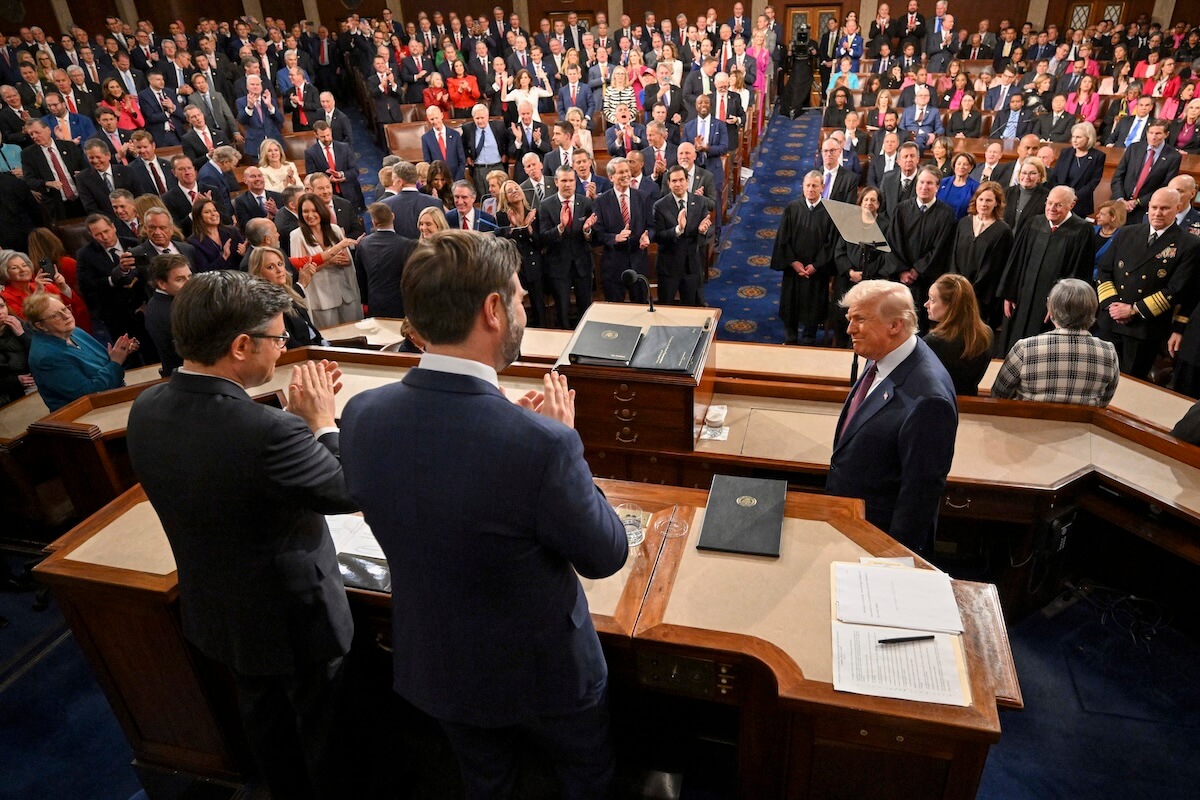
Ok, Trump’s speech last night wasn’t technically a SOTU. But the President’s address to Congress came as investors, companies and workers, international allies and domestic policymakers, scrambled to assess the actual state of the nation a month and a half into Trump’s chaotic second term.
As President, Trump told Congress he’s fighting “to make America affordable again,” even as his tariffs raise prices on thousands of products. In his speech, Trump claimed to have stopped government censorship and brought back free speech, even as he punishes protests at US universities.
Trump said he plans to balance the federal budget as he pushed $4.5 trillion in tax cuts skewed toward the rich, only partially offset by cuts to health care and other programs for the poor.
His firehose of activity is “about making America rich again and making America great again,” Trump reassured. “And it’s happening, and it will happen rather quickly. There’ll be a little disturbance, but we’re okay with that.”
Policy disruptions we’re watching:
Trouble with tariffs
Trump’s commerce secretary may already be signaling a potential retreat on tariffs slapped on Mexico and Canada this week, but the trade war is already hitting the economy.
Trump’s tariffs, including 25% on goods from Mexico and Canada, and 20% on goods from China, are expected to hit roughly a third of products coming into the US.
Financial markets, which did not take Trump’s campaign-era tariff threats “seriously or literally,” sold off on Monday and Tuesday. The S&P 500 has erased all its post-election gains. The CEOs of Target and Best Buy on Tuesday told customers to expect price hikes. The National Association Home Builders warned earlier that the levies would slow housing construction amid a housing shortage and an affordability crisis.
“The trouble with tariffs, to be succinct, is that they raise prices, slow economic growth, cut profits, increase unemployment, worsen inequality, diminish productivity and increase global tensions,” said JPMorgan’s David Kelly. “Other than that, they’re fine.”
Weaponizing diversity
Last week, The Chronicle of Philanthropy came under fire for publishing a list of foundations that may be targeted under President Trump’s executive order attacking diversity, equity, and inclusion. The article failed on multiple fronts, says Nonprofit Quarterly’s Sara Hudson.
“It compiles data without context or analysis,” writes Hudson. It is also “uncritical in its adoption of the administration’s weaponized definition of diversity, equity, and inclusion,” she says. “Treating diversity, equity, and inclusion as a lurking danger, as opposed to our national gift, is a capitulation to authoritarianism.”
Returns on aid
A billionaire’s son has some ideas. Trump has nominated Benjamin Black, son of former Apollo CEO Leon Black, to head the US International Development Finance Corp., an expansion and rebrand of the Overseas Private Investment Corp. during Trump’s first term.
USAID has experienced “absurd mission drift,” with, for example, funding for gender and climate initiatives, Black and Joe Lonsdale wrote in an essay in January. US spending abroad should “advance American interests” and seek a “return on investment,” they said.
Agents of Impact are setting the record straight. “The idea that our investment arm can choose a ‘pro-America’ agenda or a humanitarian one, obfuscates the central argument” made by multiple presidents and decades of bilateral supporters for OPIC and DFC’s work, says Anthony Bugg-Levine. “It’s in America’s national interest to use investment to help spur broadly shared wealth creation in other countries, not just pursue short-term profit for American companies.”
The aid cutbacks has upended thousands of projects and lives, and given cover to European nations to slash such spending as well.
Green bank groups in the red – and in the dark
Trump called out Stacey Abrams for her links to a federal green lending program, but Climate United, the Calvert Impact-led coalition that was awarded nearly $7 billion under the program, the Greenhouse Gas Reduction Fund, has also been a target.
On Tuesday, Climate United urged the federal government to immediately reinstate its access to the Congressionally approved funds and explain its legal basis for directing Citibank, which holds the money, to freeze them (see, EPA’s efforts to claw back ‘green bank’ funds hit a snag”).
Climate United and other awardees have been unable to access the funds for more than two weeks, leaving them unable to pay staff and contractors or fulfill loans they have approved. Despite repeated outreach to the Environmental Protection Agency, which oversees the program, Climate United says it has been rebuffed by the agency.
The 12-page letter sent by an attorney for the group lays out the timeline of events and the contractual terms and federal laws that EPA appears to be violating, including ignoring an injunction on a broad spending freeze and impounding appropriated funds.
“The current funding freeze harms the communities we serve, and we are taking the next step to ensure we can deliver on our contract,” said Climate United’s Beth Bafford in a statement. “We would appreciate the opportunity to discuss our program and workplan in detail with the EPA, and to reaffirm our commitment to full transparency and compliance with grant terms, as has been the case since we were notified of our award last April.”