The Trump administration is taking the hatchet to climate regulations in the US. Everything from public company disclosure of climate risks to an order on flood management are being slashed away in the name of “efficiency” or “anti-wokeness.”
On the other side of the Atlantic, the European Union is engaged in a lower-key effort to streamline its own mass of climate rules. And while EU lawmakers have abstained from the kind of burn-it-all-down rhetoric favored by their American peers, the mooted changes could be just as far-reaching.
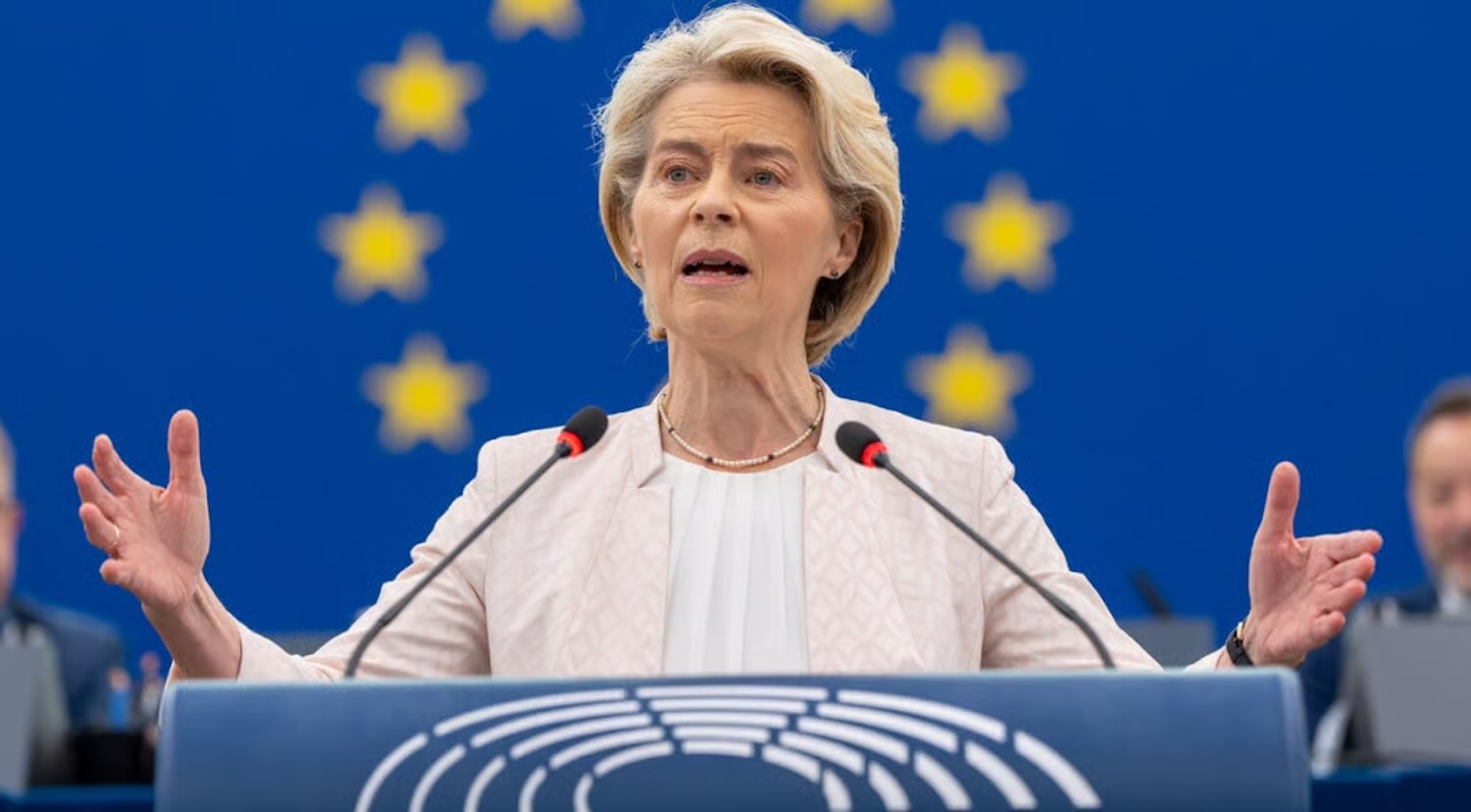
“We have a very clear signal from the European business sector that there is too much complexity,” said European Commission President Ursula von der Leyen last month. “We have to cut red tape. We will deliver an unprecedented simplification effort.”
The Commission’s actions will signal whether the EU — long a climate leader — is backing off in the face of a growing backlash, or whether it will make adjustments that enable sustainable investments in the bloc to flourish.
The reboot also has potentially vast implications for the continent’s climate adaptation efforts. Indeed, adaptation is explicitly called out in the Commission’s plan to make the EU more competitive. “Integrating climate resilience in urban planning, deploying nature-based solutions, developing nature credits and adaptation in agriculture while preserving food security” are among the proposals listed to “protect the EU economy and society from the worst of natural calamities.”
Von der Leyen’s regulatory overhaul will be carried out via three ‘Omnibus’ legislative packages, set out in a European Commission work plan issued last week. The first seeks to “simplify” three flagship sustainable finance regulations — the Corporate Sustainability Reporting Directive (CSRD), the Corporate Sustainability Due Diligence Directive (CSDDD), and the EU Sustainable Taxonomy. The second aims to simplify investment rules, and the third to exempt smaller companies from certain sustainability-related requirements.
The Commission hopes these measures will make its existing tangle of sustainability regulations easier to implement, more effective, and supportive of economic growth. Experts believe they could also bolster the EU’s climate resilience.
This is particularly true of the proposed rejig of the Sustainable Taxonomy. This is the source code for the EU’s sustainable finance framework, and has already been in force for nearly five years. Its purpose is straightforward — to align investments with the objectives of the European Green Deal: pollution prevention and control, biodiversity and ecosystems, water and marine resources, circular economy, climate mitigation, and climate adaptation.
Large EU corporates have to report how their activities align with the Taxonomy, and financial institutions that want to sell products labeled as ‘sustainable investments’ can use activities defined by the taxonomy to build eligible offerings.
In theory, creating a “common language” for sustainable activities makes sense. But in practice, the Taxonomy has proven tricky to apply for many firms. It has also long irked investors, some of whom doubt its utility.
“The Taxonomy is, as far as I’m concerned, mostly a headache,” says Seb Beloe, head of research at UK-based WHEB Asset Management, which runs a public equity investment strategy that incorporates adaptation. “[It] has most value for people who are invested in these large-footprint sectors and are looking for yardsticks to use to help them navigate the transition.”
On February 5, the Platform on Sustainable Finance, or PSF, an expert advisory group on the Taxonomy set up by the Commission, issued an 111-page bundle of recommendations on simplifying the regulation. This followed a 348-page draft report on the technical criteria underpinning it. Both documents have lots to say on adaptation, and hint at a future version of the regulation that better serves Europe’s climate-proofing agenda.
Linda Romanovska, a member of the Platform who leads on adaptation work, and head of sustainability consulting at Materra, hopes the “better, simplified, clarified wording” outlined in these documents will lead more companies to tag their activities as adaptation-aligned.
“We are coming with well-researched, evidence-based, well-argued recommendations that can significantly reduce the load on the companies. But we’re not changing much in the essence of what the taxonomy is meant to do — which is meant to identify truly sustainable economic activities,” she says.
(Editor’s Note: this article originally appeared in Climate Proof, a publication on climate adaptation finance, tech, and policy.)
Simple is Beautiful
To understand why simplification of the Taxonomy could boost adaptation, it helps to know how things currently stand.
Right now, the Taxonomy undergirds the EU’s sustainability disclosure regime, held up by the two pillars of the CSRD and Sustainable Finance Disclosure Regulation (SFDR). It therefore determines what companies say is ‘green’ or ‘sustainable’, and how financial institutions track investments in these activities.

For an activity to be ‘Taxonomy-aligned’, it has to meet four conditions. One, it has to make a “substantial contribution” to at least one of the six Green Deal objectives described above. Two, it has to “do no significant harm” (DNSH) to any other objective. Three, it has to comply with minimum social safeguards. And four, it has to meet certain technical screening criteria that determine “substantial contribution” and DNSH.
For example, the restoration of wetlands can qualify as making a “substantial contribution” to adaptation if the activity meets technical criteria like fulfilling a climate risk assessment and ensuring alignment with broader adaptation plans. To avoid falling afoul of DNSH, the restoration activity has to minimize the extraction of peat, align with nature conservation objectives, and accord to the Ramsar Convention principles and guidance on wetlands, among other things.
As this demonstrates, users have to clear a number of often high hurdles to earn that ‘Taxonomy-aligned’ badge. On the one hand, this is how it should be. The Taxonomy is informed by science, and designed to meet the high-ambition objectives of the Green Deal. There are no shortcuts to a sustainable future.
On the other hand, the long checklist of conditions, together with a Taxonomy language which users say is often hard to interpret, has led to confusion and potential underreporting of Taxonomy-aligned activities. “It’s just bewildering — no wonder companies are getting fed up with it all and looking at lobbying for it all to be cut back,” says Beloe.
There are specific challenges when it comes to adaptation. “When you’re looking at adaptation, the investable universe is smaller, and when you apply all the DNSH criteria across all the environmental objectives that universe narrows even more,” says Leo Donnachie, Sustainable Finance Lead at the Institutional Investors Group on Climate Change (IIGCC). While the criteria are useful safeguards, he says they can be challenging to meet — either because relevant data is hard to get a hold of, or because the criteria are difficult to apply due to the way they are worded, or the burdens they place on companies.
Data gathered by Morningstar, a financial services company, attests to this challenge. A recent report found that out of 575 companies reporting on adaptation for 2023, just 29 classified any of their revenues, operating expenditures, or capital expenditures as aligned with this objective.
Donnachie’s is not a fringe view, either. In a February 13 letter to European Commissioner Valdis Dombrovskis, the European Contact Group — representing accounting giants BDO, Deloitte, EY, Grant Thornton, KPMG, and PWC — called for a “fundamental review and simplification” of the Taxonomy Regulation, branding it “very complex to implement and report.
Romanovska agrees with this criticism of the Taxonomy — up to a limit. “I think some companies are kind of scared of adaptation, because it seems like something that they don’t know,” she says. But she argues that the technical criteria are not difficult. Often, they’re simply misinterpreted or their complexity oversold by outside consultants.
“You could literally comply with the DNSH criteria in half a day, [after] just a bit of accessing free-of-charge, available data or or assessments,” she claims.
Patching the Source Code
Still, the train has left the station. Simplification is the order of the day — and the PSF is rising to the challenge.
When it comes to adaptation, the Platform recommends four broad fixes to the Taxonomy in its technical report. These should make it easier for companies to apply the adaptation criteria and increase reporting of climate-proofing activities.
First, better aligning the Taxonomy’s adaptation objective with EU and international policies, like those enshrined in the Paris Agreement. To this end, the PSF proposes a new “headline ambition” statement that makes plain how the adaptation objective applies to economic activities in “a measurable and monitorable way”.

“The whole big principle of how we think about adaptation in the Platform is we are committed to achieving a fully climate-resilient economy. That is written in the EU’s adaptation strategy. So we need to match that objective to try and achieve that,” says Romanovska.
Second, restructuring the generic technical criteria for adaptation activities to “improve usability”. Specifically, the PSF wants to align them better with standard climate risk assessment practices and adaptation planning, ensure that the threat of “maladaptation” is taken care of, and address the wording of certain criteria so that they are simpler to follow.
Anne Chataigné, Adaptation and Resilience Lead at the IIGCC, thinks the proposal could go further. “At the moment there is a sole focus on risk, but it could be a missed opportunity. Indeed, there needs to be a narrative shift moving from merely disclosing the risk and potential unintended consequences towards managing that risk and considering co-benefits and investment opportunity,” she says.
Donnachie adds that it would be “helpful” if investors were able to disclose investments that make a “substantial contribution” to adaptation, even if they don’t currently meet the DNSH criteria. Such investments may not qualify for a ‘Taxonomy-aligned’ label, but could prompt better disclosure and, in turn, public understanding of how capital is being put to work on adaptation issues.
Thirdly, clearing up how an “adapted” activity can become an “enabling” activity. Right now, the regulation tells users to flag activities as “adapted” if they directly climate-proof company operations and supply chains, “enabling” if they help other activities to become adapted, and “adapted-enabling” if they do both.
Clarification On “Adapted”, “Adapted-Enabling” And “Enabling” Activities

The PSF says users have struggled to determine the boundaries between these categories. In turn, this has led companies to shy away from classifying “enabling” activities, resulting in potential underreporting of their adaptation-related revenues or, on the flip side, to incorrectly classify “adapted” activities as “enabling”, too.
Clarifying the three buckets of activities could spur more companies to report “enabling” activities, while stopping improper labelling of “adapted” ones. The end-result should be a fair indication of how much capital is being invested in adaptation, and how much revenue climate-proofing activities are bringing in for companies.
Fourth and finally, expanding the array of sectors covered by the adaptation objective. The Taxonomy started out by classifying only those activities that can most benefit the EU’s climate transition and adaptation goals. Bunching the two objectives together, though, meant some climate risk-prone sectors were left out.
“All the sectors that were considered for mitigation were taken and copy pasted and put into adaptation. There were no capacities, there was no budget or anything to do a proper prioritization study to identify the highly vulnerable sectors and include them as a priority, which would be a logical way to go about adaptation,” explains Romanovska. This led to a “massive gap” that the PSF is now looking to fill.
Economic Activities & Sectors By EU Taxonomy

Source: ‘Factsheet: Sustainable Finance — Investing in a sustainable future’, European Commission
As things stand, out of the three most climate-vulnerable sectors — health, biodiversity, and water management — only water management is “almost fully covered” by the Taxonomy’s adaptation component, according to the PSF. Even more glaring, not a single agricultural activity is covered, despite the fact European farms are already struggling to operate under a cascade of climate shocks.
Activities that cover the construction of climate-resilient buildings are missing from the current rulebook, too. Hence why the PSF “strongly recommends” including highly vulnerable economic activities in the Taxonomy under the adaptation umbrella.
“The argument is: include under ‘adaptation’ as many activities as possible and as quick as possible,” says Romanovska. “Unless we have a big range of them there — and they can benefit from then being able to claim all the money they invest in adaptation measures as Taxonomy-aligned — we will not see the resilient economy that we want.”
What’s next?
Hundreds of pages of recommendations, and not just from the PSF, will inform how EU lawmakers go about refashioning the Taxonomy as part of the Omnibus proposal, which is expected to be issued on February 26, but may be delayed.
A potentially messy legislative back-and-forth will follow. Already, some EU member states are making their concerns with the process known. The UN is getting in on the action too, with one working group calling on the EU to not reopen the text of the CSDDD.
When it comes to the Taxonomy, though, there’s a clear appetite for some creative thinking — especially if it encourages more corporate investment in adaptation, and financial institution engagement with the theme. The IIGCC’s Donnachie believes the PSF is piloting a sensible course, branding its recommendations “the best solution” for balancing the core objectives of the Taxonomy with usability.
Beloe at WHEB, however, isn’t so sure the Taxonomy can ever be refined into something useful for an investment professional in his role. “Some parts I can think will be useful … but much of it is not, and it’s a distraction. Adaptation – it can be everything. It should be everything. All these communities around Europe will need to adapt to some degree or other. I don’t know what that looks like from Taxonomy point of view.”
Romanovska is more bullish. She says investors want the Taxonomy expanded as they already use it to allocate capital. Activities that aren’t covered by the classification system, in contrast, are often passed over. It’s a dynamic that can’t go on if the EU hopes to meet its adaptation goals.
“How do we achieve a resilient economy? We achieve it by incentivizing every little part of the economy to take care of their risks, and the individual parts of the economy are the individual businesses and the individual activities. If we are incentivizing everyone to do a risk assessment and, if they see any risks there, actually address them, we will achieve a resilient economy,” she says.
_________________________________________________________________________________
Louie Woodall is the editor of Climate Proof, a publication on climate adaptation finance, tech, and policy.