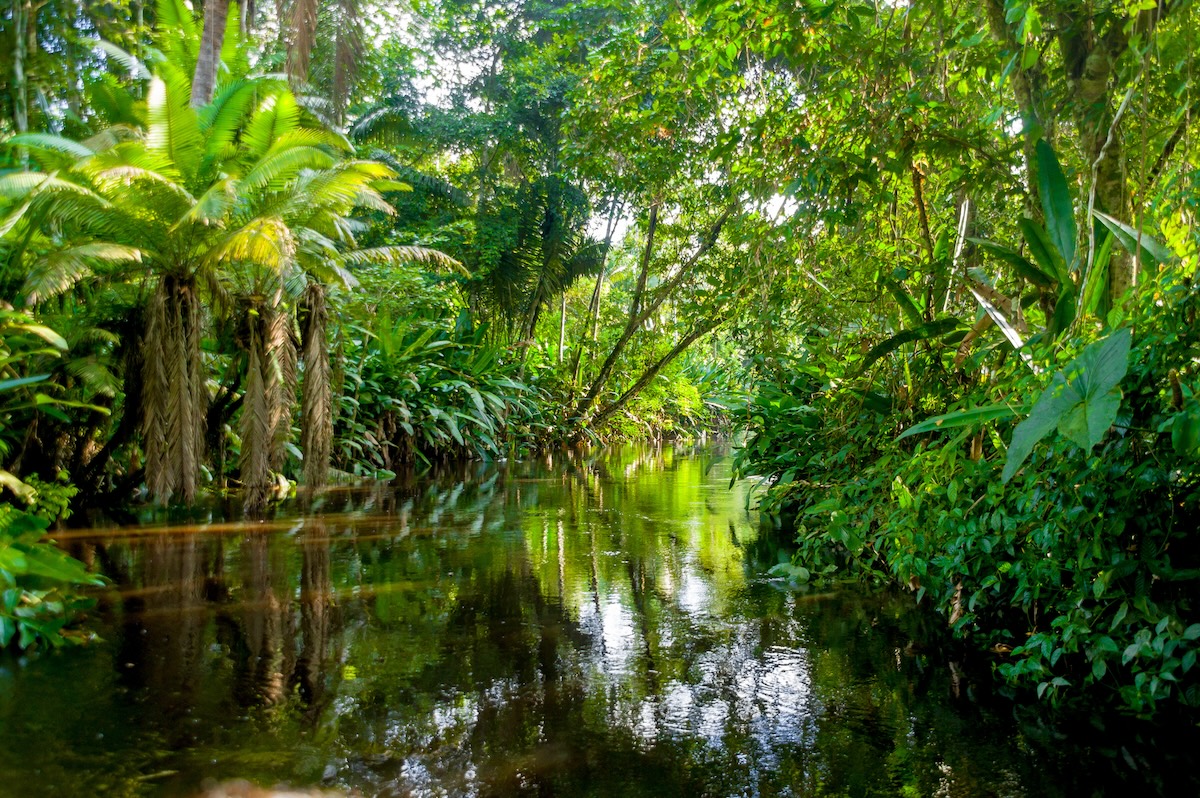
The South American country is one of the most biodiverse places in the world. Protracted economic, political and security crises have forced Ecuador to renegotiate its debt obligations and reshuffle financial resources. A new debt package will ensure that the country is also able to prioritize and fund critical nature conservation initiatives.
Ecuador has secured $1 billion for a new debt package that will allow it to buy back $1.5 billion in sovereign bonds, most of which are slated to mature in 2030 and 2035, and funnel an estimated $460 million to protected areas in the Amazon over the next 17 years.
Such “debt for nature” swaps are designed to help low- and middle-income countries ease their debt obligations and free up capital for nature protection that would otherwise go to making interest payments. The deal is Ecuador’s second debt for nature swap. Last year it refinanced $1.6 billion in debt to invest in protection of the Galapagos Islands.
Milestone deal
The deal is the sixth and largest debt for nature swap facilitated under The Nature Conservancy’s Nature Bonds program. It is also the first focusing on land and freshwater ecosystem protection; the other five – in the Seychelles, Belize, Gabon, Barbados and the Bahamas, which closed last month – have all focused on marine conservation.
TNC’s Melissa Garvey called it a milestone for nature and biodiversity preservation. “We’re expecting to be able to unlock $1 billion dollars through these six projects.”
The project also included upfront input from 11 Indigenous nations in Ecuador that will be involved throughout the life of the program.
Ecuador’s Galapagos bond, which is not part of TNC’s Nature Bonds program, has faced scrutiny over lack of transparency and community engagement. A resolution to a complaint lodged with the Inter-American Development Bank’s oversight body agreed to strengthen the project’s governance and provide capacity building to enable greater local participation.
Capital mobilization
About $700 billion in biodiversity financing is needed annually. “We’re not going to solve it with debt conversions,” Garvey told ImpactAlpha, “but they are no longer so niche.”
Financing on the new Ecuador deal, which was arranged by Bank of America, included a number of repeat debt-for-nature investors, including Legal & General Asset Management, which also invested in the Galapagos bond. L&G’s Jake Harper called debt for nature swaps an “attractive investment opportunity for institutional investors that can deliver strong returns over the longer-term, alongside positive environmental and social outcomes.”
Risk mitigation mechanisms, like the political and credit-risk guarantees provided by the US International Development Finance Corp. and the Inter-American Development Bank in this deal, are still necessary to bring in commercial investors. The Bahamas debt-for-nature swap last month saw a family office, Lukas Walton’s Builder’s Vision, step into the role of catalytic supporter for the first time. Builder’s Vision provided a $70 million credit risk guarantee on the Bahamas’ new $300 million debt package.
“What we’re hoping to prove is that family offices and other pools of capital can play a unique role to support and catalyze investments for projects like this,” Builders Visions’ Rebecca Carland told ImpactAlpha. “We need to increase the community of people that are doing these deals and doing them in a truly authentic way.”